Federal Budget Appropriations and Legislative Strategy
Build confidence in shaping federal spending priorities
Mastering federal budget appropriations strategy is critical for government affairs professionals who want to effectively advocate for their clients and drive better results. Throughout the appropriations process, they must pay attention to the potential impacts of federal discretionary spending on their clients or organizations, understand the policy implications of appropriations, and push for a budget that aligns with their advocacy goals.
Bloomberg Government’s unparalleled resources and workflow tools give public affairs professionals the confidence to understand, respond to, and shape spending priorities.
Federal budget topics
Essential resources to track and influence federal spending
Key Takeaways
- Understand the process: The federal appropriations process determines how Congress allocates discretionary funding to agencies and programs, distinct from mandatory spending like Social Security and Medicare.
- Seize opportunities: Key moments in the appropriations timeline, such as subcommittee hearings and amendments, offer critical chances to influence funding levels and policy directives.
- Leverage tools: Advanced tracking platforms, like Bloomberg Government, simplify budget monitoring, provide real-time insights, and help professionals strategically engage with lawmakers and stakeholders.
The federal budget appropriations process is how Congress allocates discretionary funding to federal agencies, departments, and programs each fiscal year (Oct. 1 -Sept. 30). It’s distinct from mandatory spending on programs such as Social Security and Medicare and debt interest payments, which are set by other laws.
Discretionary spending is subject to annual approval and covers things such as:
- Defense
- Education
- Transportation
- Health research
- Homeland security
In this strategic guide, learn about the federal budget appropriations process, and gain insights to better anticipate outcomes and plan accordingly for FY 2026 and beyond.
[Download our comprehensive Guide to Federal Budget Dynamics for an overview of the federal budget process and a breakdown of the appropriations process, legislative maneuvering, and strategic implications.]
Watch: Why Congress So Rarely Passes Government Funding Bills on Time
In this video, we look at how the current budgeting process is supposed to work and the way it actually plays out most of the time, and try to answer why it’s so hard for the federal government to fulfill one of its most basic functions: funding itself on time.
The federal appropriations process and timeline
The Constitution gives Congress the “power of the purse,” which means federal spending and taxes require legislation to be enacted. Staying on top of the many moving parts can be a complicated and time-consuming endeavor.
In general, the federal budget process can include seven elements:
- President’s budget request
- Budget resolution
- Appropriations bills
- Authorization bills
- Revenue measures
- Budget reconciliation
- Debt limit legislation and raising the U.S. debt ceiling
Once the president’s budget request is submitted, the House and Senate Budget committees are supposed to craft a budget resolution. Increasingly, Congress hasn’t been able to agree on a budget resolution and instead adopts a “deeming resolution,” a legislative substitute that deems certain budgetary levels or procedures to be in effect, even without a full budget blueprint in place.
After a budget resolution (or a deeming resolution) is adopted and the overall discretionary total or 302(a) allocation is set, it’s divided among the 12 appropriations subcommittees in both the House and Senate as part of a process known as 302(b) allocations.
The appropriations process is meant to run from May to September, though timing has fluctuated in recent years, during which time each subcommittee drafts its appropriations bill for the agencies under its jurisdiction.
These appropriations bills specify how much funding each program and activity get, and may include policy provisions called “riders” such as provisions restricting how money can be spent.
This is often the most important window for sector-specific appropriations lobbying. It offers the most direct opportunity to influence funding levels for specific programs and add legislative language such as policy riders, directives, or restrictions. Lobbyists also fight for inclusion of language in committee reports that benefit their clients.
Amendments can still be introduced at the full committee level and during House and Senate floor debates, to adjust either funding levels or policy riders.
If House and Senate versions of a bill differ, lawmakers can reach informal agreements or use a conference committee to resolve differences. Funding levels or provisions cut earlier can sometimes be reinstated here. This stage is another opportunity to use direct lobbying or grassroot strategies to shape final decisions.
[Learn more about the budget process with our comprehensive guide, including a detailed timeline, step-by-step explanations, and an overview of how federal budgets affect state finances.]
Authorization vs. appropriation
When monitoring federal funding debates, it’s important to distinguish between authorization and appropriations bills.
Authorizations generally refer to any statutory provisions that relate to the authority of the government to act. While authorizations alone do not set funding for government activities, they can “establish or continue a federal agency, program, project, or activity.”
Congress passes a National Defense Authorization Act each year to authorize activities at the Pentagon and other agencies, while other authorizations are considered every few years.
Authorizations permit Congress to spend funds for a particular purpose (not necessarily that it will spend the funds), while appropriations bills provide agencies with the budget authority to make the actual payments.
Budget resolutions, spending bills, and continuing resolutions
Congress generally holds hearings during the budget process, where it can question administration officials about their requests. The House and Senate Budget committees then create and enforce the congressional “budget resolution,” an internal blueprint that includes the total of new spending, both for budget authority and outlays, and the total of federal revenue (and the amount that federal revenues would have to change based on anticipated legislation).
This plan covers at least five fiscal years and is final after the House and Senate adopt identical measures, either by one chamber accepting a resolution adopted by the other chamber, or when they settle on a conference agreement. And the plan does not go to the president for approval or veto (so is not considered law).
To set the federal budget, Congress must produce 12 appropriations bills (also called spending bills, with one for each set of subcommittees on the House and Senate appropriations committee) for each federal fiscal year.
If Congress does not pass all federal budget appropriations measures by the start of the fiscal year, and the president has not approved these measures, it has to enact a continuing resolution (CR), which it must present to the President for approval to keep the government running and avoid a forced government shutdown for nonessential discretionary functions.
Key deadlines and what happens when Congress misses them
There are various deadlines for the budget process, including those that follow.
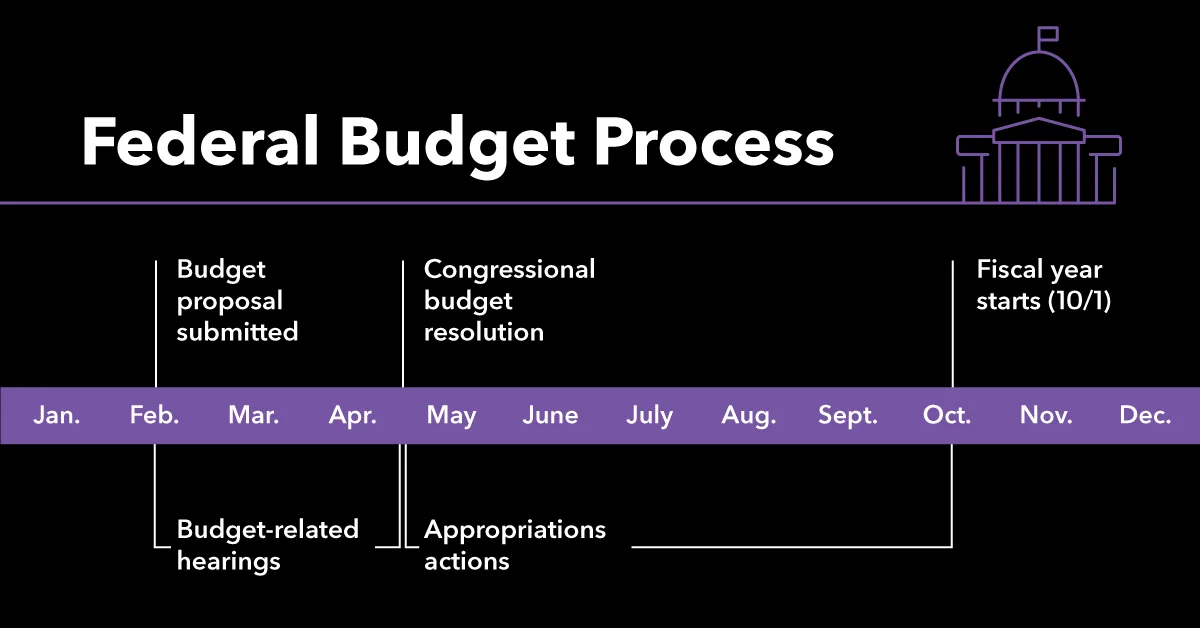
Administration budget request
The Congressional Budget Act of 1974 calls for the administration to submit its budget request to Congress by the first Monday in February every year. But administrations do not always meet this deadline. For instance, in 2025, the administration issued a “skinny budget,” a top-line request, on May 2.
Budget reconciliation
The congressional budget resolution is supposed to be filed by April 15 for the fiscal year that begins Oct. 1. But because Congress determines if and when it will complete that process, it does not always complete action on these resolutions for each fiscal year.
When Congress does complete this resolution, it often does not do so by the deadline. In recent years, the House and Senate often have carried out substitute legislative measures called deeming resolutions, which typically bind only each chamber’s appropriators.
That said, if a budget resolution is filed, it can include instructions to committees to report reconciliation legislation, often with a stated deadline, to meet spending and revenue targets.
Appropriations
The House may begin its consideration of appropriations bills on May 15, even in the absence of a budget resolution. Practically speaking, Congress is supposed to pass all appropriations measures by the start of the new federal fiscal year on Oct. 1. If Congress and the president do not reach agreement on spending levels on time, Congress must enact a continuing resolution to keep the government running.
There are often delays with this process. Since the current system for budgeting and spending tax dollars was established by the 1974 budget act, Congress has passed all its required appropriations measures on time on only four occasions: fiscal years 1977 (the first full fiscal year under the current system), 1989, 1995, and 1997, Pew Research Center reports.
Continuing resolutions are common and often continue federal spending at the present level, which allows additional time for the appropriations process. A partial government shutdown may occur if Congress has passed some appropriations bills, but not all of them.
Debt limit measures
The federal government imposes a limit on the amount of debt it can incur, and sometimes must take action on these matters. So, Congress considers legislation to either increase the dollar amount in law or suspend the debt limit for a period of time to allow the government to take steps to finance the difference between the amount of revenue brought in and the amount of spending required by law.
If Congress does not increase the debt limit and the government defaults on its legal obligations, some government officials warn it would be an unprecedented and catastrophic economic event.
In the more than a century that the debt ceiling has existed, it’s been revised more than 100 times, most recently in the bill Congress approved July 3, which lifted the $36.1 trillion cap by $5 trillion to avoid the government breaching the debt limit later in the summer.
[Download our comprehensive Guide to Federal Budget Dynamics to master the complexities of appropriations, budget reconciliation, and strategic advocacy.]
Who holds the purse strings: key players and committees
The federal appropriations process is shaped by several powerful players with distinct authorities. The president influences funding priorities through the annual budget request and holds veto power over final appropriations bills.
In Congress, the House and Senate Budget Committees determine the overall discretionary spending limit through a budget resolution, while the House and Senate Appropriations Committees control how that funding is divided among government functions. The 12 appropriations subcommittees in each chamber wield substantial power by deciding program-level funding and policy directives within their jurisdictions.
Congressional leadership – including the speaker, Senate majority leader, and other party leaders – broker high-stakes negotiations, set legislative priorities, and intervene in funding disputes. Finally, conference committees composed of selected House and Senate members reconcile competing versions of appropriations bills, determining the final legislative text sent to the president.
House and Senate Appropriations Committees and subcommittees
In the early stages of the congressional budget process, the budget committees in the House and Senate work separately to determine top-line figures for federal revenues, mandatory spending, and discretionary spending.
In each chamber, the discretionary spending target is divided across various areas, so that each subcommittee gets its own 302(b) allocation to set priorities. Each subcommittee then writes a bill that must pass both chambers and be signed by the president to take effect.
Subcommittee hearings during this process offer government affairs professionals a place to build support for their programs or priorities – and generally allow subcommittee members to elicit facts, determine if program priorities need to be changed, and track whether funds are administered in alignment with congressional directives.
This is a busy time for congressional staff, as they must complete a variety of tasks, including vetting federal spending bills requests, conducting research to ensure agencies can use the funding, and working with internal and external stakeholders to gather the technical information to complete subcommittee forms (as subcommittee forms have different formats and the staff are the ones who can access these documents).
How external stakeholders can influence outcomes
Stakeholders such as federal agency officials and lobbyists can play an influential role in the appropriations process.
For example, they can use public campaigns and communications to draw support for their causes – such as statements to the media or communications stemmed by coordinated grassroots campaigns – and can build alliances among other stakeholders and policymakers to generate support for their goals.
External stakeholders also can wield behind-the-scenes influence by providing briefing information and potential areas for questioning to subcommittee members’ staff to help them prepare for hearings. Lobbyists also can write legislation or submit language for consideration.
And these stakeholders can participate in the markup process by providing the key information needed for the appropriations committee reports that issue guidance to agencies on spending – with work potentially including outlining how specific funds will be spent and why funds are necessary.
To do this strategic work, external stakeholders must follow the progress of legislation and develop expertise on complex policy topics in order to analyze data and break down key considerations for lawmakers.
In addition, these professionals should be prepared to advise their clients not only about their advocacy efforts but also about the technicalities of fiscal law and the budget process, as the budget process has become increasingly complex during these uncertain times and clients may have additional queries and concerns.
Executive branch role: OMB and agency budget requests
Federal budget planning at the agency level can start 8 to 10 months before the president submits a budget request, so working with federal agencies early can help government affairs professionals advance their projects through the congressional budget process.
Federal agencies then create budget requests that they submit to OMB in the fall, about four to five months before the administration is supposed to submit its budget to Congress. Agencies also submit detailed budget justifications that include information on what the agency is seeking for each of its programs and why they’re requesting any changes.
Although the president does not have legal authority to set federal budget appropriations, the president’s budget request does influence the size and composition of appropriations and can set the tone for Congress. Executive influence also continues because the president must sign or veto each appropriations bill.
Legislative maneuvering and strategic implications
The federal appropriations cycle includes many chances for lawmakers and external stakeholders to exert influence.
After each appropriations committee divides the 302(a) allocation into the 12 302(b) allocations, these leaders then draft bills for their specific allocations to divide resources for the agencies and programs that their subcommittee oversees.
These leaders can then direct the subcommittee discussions that follow, as the bills go through the amendment process within appropriations committees (also known as markups). When these bills come before the full chamber, the full body can then debate them, amend them, and vote on them, with differences between House and Senate bills reconciled in a formal or informal process before returning to each chamber for a final vote.
So, in addition to exerting influence related to examining funding levels and holding hearings, lawmakers can shape the congressional appropriations process in other ways.
For example, when a bill goes to the floor of each chamber, individual lawmakers can offer amendments to bills for elements such as funding levels or the addition of provisions – or by offering objections or points of order for amendments (because certain measures can limit certain aspects of amendments).
Lawmakers also can sign “Dear Colleague” letters of support to influence committee leaders, work with external stakeholders to grow support for their goals, or request to include or exclude items in the ultimate government funding bill.
Lawmakers on subcommittees also can influence outcomes via committee reports, which are explanatory reports that accompany bills to explain congressional intent. Although Congress does not formally vote on these reports, agencies often follow these documents’ directives.
[Navigate the complexities of the federal budget process with confidence with our Guide to Federal Budget Dynamics. It covers everything from appropriations to budget reconciliation to legislative strategy.]
The return of earmarks and policy riders
In the federal budget appropriations process, earmarks (also known as “congressionally directed spending”) are allocations of funding for a specific project, program, or organization. Leaders used the practice for political bargaining to gain support by allocating funds for projects in particular members’ districts.
Congress restored earmarks in 2021 after a decade-long pause after some controversial examples – such as the more than $220 million set aside for the $398 million Gravina Island Bridge in Alaska (aka the Bridge to Nowhere).
In general, “earmarks have always composed a miniscule portion of the discretionary budget, typically less than one percent,” according to data reported via the nonprofit Brookings Institution.
Some proponents have argued earmarks are a tool that can benefit communities, while others have argued the benefit of earmarks to help ease gridlock in Congress outweighs their financial costs.
So, if government affairs professionals determine earmarks can help their cause, these professionals also should do the advance work to determine whether earmarked funding would be helpful or hurtful to any partners or lawmakers who are opposed. And it’s important to note that getting earmarked funding today can be more challenging, in part because of increased oversight of budget expenditures.
Policy riders also offer risks and opportunities as lawmakers use must-pass bills to advance their priorities. Riders have become more common, and may note things like prohibitions for agencies to use funds in certain ways that lawmakers oppose, or make policy changes that seek to lower the cost of programs. When the House and Senate take different approaches to riders, it can be even more difficult to pass appropriations bills.
Ideally, government affairs professionals can be involved in the early process of the federal budget so they can help prevent the addition of undesired riders or advance their preferred language for one. If that is not possible, government affairs professionals should determine which bills are likely to carry riders and then use legislative tracking software to identify riders that may affect the advocacy that they’re carrying out for their clients.
Once identified, government affairs professionals can then research these riders (including information on sponsors and potential impacts on stakeholders and their clients) – and use advocacy strategies in support of or against the riders.
Endgame bill packaging tactics
Congress routinely packages appropriations bills together rather than passing all 12 individually.
In some years, all the bills are combined into a consolidated “omnibus” measure – forcing lawmakers to take up or down votes on all funding at once. Lawmakers have also used “minibus,” combining some of the regular appropriations bills.
These consolidated measures “have been a common feature of the appropriations process since 1982,” with at least one measure containing two or more regular appropriations acts being signed into law for 29 of the 42 fiscal years from FY1983 through FY2024, according to Congress.gov.
Budget advocacy and stakeholder engagement
Government affairs professionals need to consider a multipronged strategic approach advocating for their clients on the federal appropriations process.
Agency contacts are a helpful source of information and advocacy because they work behind the scenes with lawmakers as they craft spending bills.
The House and Senate committees typically outline their process for earmarks early in the year, and government affairs professionals can help clients navigate the steps. They can help identify supportive members of the committee who can request earmarks, propose amendments, and send “Dear Colleague” letters to gain support.
Floor debate offers another opportunity to persuade members to support or oppose amendments.
Coalitions with external supporters can also help, because a clear message with wide or high-profile support can help legislators feel more comfortable or motivated to take on issues.
And sharing clear data is another tool for persuasion here. In advance of decision points, government affairs professionals should convey the financial and other returns of investment in their client’s programs or policies. Data can include details that support federal budget appropriations requests (such as justification for funding and staffing changes) as well as performance metrics of programs that include data and relevant case studies on outcomes and impact.
Using Bloomberg Government for budget tracking and analysis
The appropriations process has always been complex. But now it can feel especially overwhelming due to today’s fast-moving and uncertain environment. To keep pace with change, government affairs professionals rely on Bloomberg Government’s time-saving tools and in-depth news and analysis.
With Federal Funding Flow, get access to budget documents, funding allocations, up-to-date spending data, and information on congressional appropriations and subcommittees – all in one place.
Gain real-time insights into the federal budget preparation process from appropriations bills to committee reports, enabling you to track and analyze government priorities and spending patterns. Our platform also seamlessly links budget proposals to actual agency spending, providing a clear view of how appropriated funds are utilized.
And to help teams confidently connect with members of Congress and their staff, our detailed congressional directories offer biographies, speech and hearing transcripts, and any applicable summaries of sponsored bills for members.
With these helpful tools and more, Bloomberg Government gives busy professionals everything they need to understand, respond to, and shape policy and spending priorities.
Request a demo to see how Bloomberg Government simplifies the budget tracking process, helping lobbyists and government affairs professionals stay up to date and influence the allocation of government funds.