Navigate federal budget uncertainty with real-time insights
The federal budget process is increasingly marked by uncertainty and contentious debates over spending priorities and the deficit. However, using our tools and intelligence, you can gain real-time insight into each phase of the appropriations process – from agency requests to committee markups – so you can support strategic planning with data-backed confidence.
Federal budget topics
Track and influence the budget process with smarter tools
Federal Funding Flow
This interactive flow diagram makes it easy to navigate the end-to-end process – from agency request to enacted laws to contracts and task orders.
Budget focused news
A must-read newsletter that brings you daily insights on the federal budget appropriations, and more is sent straight to your inbox whenever Congress is in session.
Historical spending data
By linking budget proposals to actual agency spending, we provide a clear view of how appropriated funds are used.
When a new fiscal year begins, Congress, in theory, should have passed all 12 appropriation bills to keep federal agencies and operations running without disruption. However, that is seldom the case. The last time appropriations were passed on time was in 1997. Instead, lawmakers rely on short-term fixes, including continuing resolutions (CR), to prevent the government from shutting down and pass minibus and omnibus packages after often lengthy negotiations.
Though there is no penalty for missing budget deadlines, the process is supposed to be straightforward, with the president submitting a budget request in early February and Congress securing funding by Oct. 1. But in practice, it’s mired in delays and debate.
Understanding how this system is supposed to work – and why it so often breaks down – is essential for anyone seeking to engage with public policy. In this article, we’ll unpack the fundamentals of the federal budget process, including the stages, timelines, and players involved, to gain insight into how fiscal decisions are made and the impact those decisions have on everything from infrastructure to social security.
[Download our comprehensive Guide to Federal Budget Dynamics to master the complexities of appropriations, budget reconciliation, and strategic advocacy.]
What is the role of Congress in the budget process?
Congress holds the constitutional power of the purse, but this authority has faced debate during Trump’s second presidency. While the president proposes a budget each year, only Congress can authorize programs, appropriate funds, raise revenues, and set borrowing limits. Specifically, they are responsible for:
- Reviewing and responding to the president’s budget
- Adopting a budget resolution
- Authorizing federal programs
- Appropriating funds
- Passing revenue measures
- Using reconciliation
- Raising or suspending the debt limit
- Weighing administration proposals to rescind funding
The Congressional Budget and Impoundment Control Act of 1974 codified this role by establishing procedures, committees, and deadlines to guide fiscal decision-making. However, competing policy agendas and institutional dysfunction has disrupted this process, leading to missed deadlines, CRs, and debt ceiling crises – all of which Congress must contend with on an annual basis.
The timeline for the federal budget
What’s the federal budget approval process?
The federal budget approval process, as outlined in the Congressional Budget and Impoundment Control Act of 1974, was designed to give Congress a framework to evaluate the president’s budget, set fiscal priorities, and pass the legislation needed to fund the government each year.
Due to partisan divisions and competing policy agendas, the approval process is routinely derailed. Even if the federal budget isn’t finalized until after the new fiscal year begins, lawmakers typically go through these steps:
1. President’s budget request
The federal budget process begins the first Monday after Labor Day when agencies submit their requests to the Office of Management and Budget (OMB), an office within the Executive Office of the President.
OMB reviews these requests, provides feedback, and notifies agencies of their approved budgetary decision through a process called “passback.” During passbacks, agencies have a 72-hour window to make any appeals.
Once a settlement direction is made, OMB submits a finalized budget to the president, and the president then submits the proposed budget to Congress by the first Monday in February, though this often gets pushed to a later date.
2. Budget resolution
Once the president’s budget request is submitted, the House and Senate Budget Committees review the request but are under no obligation to follow it. Instead, each committee crafts their own versions of a budget resolution.
A budget resolution is a concurrent resolution, which doesn’t need the President’s sign-off but must be agreed upon by the House and Senate. It outlines spending and revenue targets for the upcoming fiscal year. Ideally, in late February, each chamber brings their respective resolutions to the floor for markup, and they then adopt a finalized version by April 15. This deadline is seldom met.
Increasingly, Congress hasn’t been able to agree on a budget resolution and instead adopts a “deeming resolution,” a legislative substitute that deems certain budgetary levels or procedures to be in effect, even without a full budget blueprint in place.
3. Appropriations bills
After a budget resolution (or a deeming resolution) is adopted, Congress weighs 12 separate appropriations bills, one for each subcommittee of the House and Senate Appropriations Committee.
By having a 12-bill structure, Congress, in theory, can scrutinize the priorities and tradeoffs of each major area of government more rigorously, rather than passing one sweeping bill. Appropriations bills are supposed to be completed by Oct. 1, when the new fiscal year begins. However, Congress rarely meets this target date.
When deadlines are missed, lawmakers can buy extra time by passing a continuing resolution (CR), which essentially freezes agency budgets at prior fiscal year levels unless there are specific adjustments. CRs can last a few weeks or fund the government for the remainder of the fiscal year.
If a CR isn’t preferred, Congress can use another funding mechanism: An “omnibus” or “minibus” package. These packages bundle appropriations bills into one large piece of legislation. Whereas CRs are mainly designed to preserve the status quo, substantive funding and priority shifts can occur within either an omnibus or minibus.
What’s the difference between the budget and appropriations?
4. Authorization bills
Authorization bills provide the legislative authority to establish, continue, or modify federal agencies or programs. These bills authorize the expenditure of money, whereas appropriations supply the actual funding.
For example, every year, Congress passes a National Defense Authorization Act. The NDAA authorizes appropriations for the Department of Defense (DoD) to run its programming and operations for a fiscal year. On the other hand, the Defense Appropriations Act provides budget authority for defense-related activities, including funds for procurement, military personnel, and research and development.
5. Revenue measures
The goal of revenue-raising bills is to help fund the government through taxation, namely individual and corporate income taxes, excise taxes, payroll taxes, tax credits, custom duties, and other revenue. Congress doesn’t have to consider tax legislation every year and is often prompted to take up measures when provisions are set to lapse.
Under the Origination Clause in the Constitution, all revenue measures must originate in the House of Representatives. But just like with other bills, the Senate can weigh in, with proposed amendments.
When Congress passes tax cuts, federal revenues usually fall, unless offset by spending cuts or economic growth. Such was the case when President Trump signed the Tax Cuts and Jobs Act (TCJA) into law in 2017.
6. Budget reconciliation
Established by the Congressional Budget and Impoundment Act of 1974, budget reconciliation is a powerful legislative tool that allows Congress to fast-track certain tax and spending packages without needing a 60-vote supermajority in the Senate.
To leverage reconciliation, lawmakers must include reconciliation instructions in a budget resolution, directing committees to produce legislation that meets specified spending and revenue targets. The committees send their recommendations to the House and Senate Budget committees, which consolidate the proposals into a single bill that then goes to the floor.
Senate debate is limited to 20 hours, and reconciliation bills are shielded from the Senate filibuster. In spite of these procedural advantages, reconciliation bills are subject to the “Byrd Rule.” Named after late Sen. Robert Byrd (D-W.Va.), the Byrd Rule bars provisions that don’t have a budgetary impact, would make changes to Social Security, or increase the federal deficit outside a 10-year budget window.
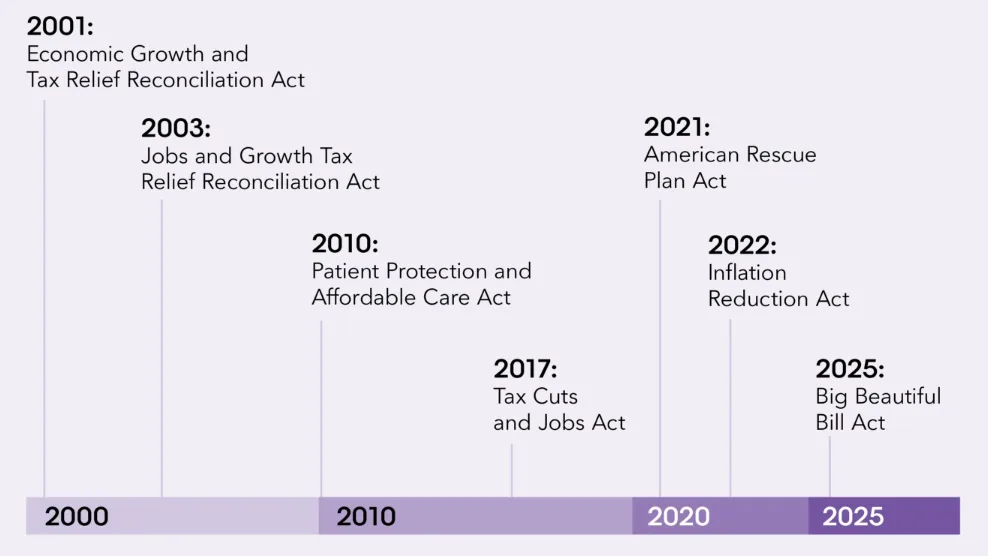
The process has been used to pass sweeping measures and meaningfully transform tax and spending law. For example, President Trump and Congress used reconciliation in 2017 to pass the Tax Cuts and Jobs Act and deployed it again to make key provisions of that legislation permanent with the “One Big Beautiful Bill Act” in 2025.
Reconciliation bills in recent history
7. Debt ceiling legislation
The debt ceiling is a statutory cap on how much money the Treasury can borrow to cover legal obligations, including paying Social Security benefits, government and military salaries, interest on the national debt, etc. When the Treasury approaches the debt limit, Congress must pass legislation to raise or suspend the debt ceiling to prevent a default. Failure to act could undermine the full faith and credit of the US, leading to market volatility, higher borrowing costs, and a potential recession.
In 2023, Congress passed the Fiscal Responsibility Act (FRA), which temporarily suspended the debt limit until January 2025. The Treasury Department has been using maneuvers to operate within the cap. But those tools will expire later this year, making the debt limit an immediate and acute concern for Congress.
[Download our comprehensive Guide to Federal Budget Dynamics for an overview of the federal budget process and a breakdown of the appropriations process, legislative maneuvering, and strategic implications.]
What is the difference between mandatory and discretionary spending?
Federal spending can be split into three main categories: Mandatory spending, discretionary spending, and net interest. In FY25, about 62% of the budget went toward mandatory spending, 24% flowed to discretionary programs, and 14% was spent on net interest. Generally, these figures are consistent with most fiscal years, where mandatory spending exceeds discretionary spending.
1. Mandatory spending
Mandatory spending is the federal expenditures required by law, not the annual appropriations process. Congress sets benefits and eligibility rules through authorizing legislation, and funding adjusts automatically based on those criteria.
Examples of mandatory spending include:
- Social Security
- Medicare
- Medicaid
- Income security programs
- Veterans’ programs
- Federal civilian and military retirement
- Agricultural support
- Student loan interest subsidies
Mandatory spending as a share of gross domestic product (GDP) has been climbing year-over-year and is projected to reach 14.3% in 2025. This indicates that entitlement spending is growing faster than the economy itself.
2. Discretionary spending
Discretionary spending occurs on an annual basis to fund federal agencies and programs. Unlike mandatory spending which occurs automatically, discretionary spending is determined through the appropriations process.
The discretionary ledger is broken into two primary categories:
- Defense: More than half of the discretionary budget supports the military, including personnel, operations, R&D, and nuclear security.
- Non-defense: The other portion of discretionary funds goes toward education, public health, infrastructure, science and technology, environment, housing and urban development.
3. Net interest
Net interest is the third-largest category of federal spending. As interest payments grow, they crowd out discretionary investments – as in, every dollar spent on interest is a dollar unavailable for public health, infrastructure, education, R&D, and other critical federal programs.
There is no simple lever to reduce interest. Reducing the deficit would mean either cutting spending – with the biggest potential reduction from politically difficult changes to entitlements – or raising taxes.
What is the relationship between the federal budget and shutdowns?
Government shutdowns occur when there’s a lapse in appropriations – when Congress can’t agree on spending bills or a continuing resolution by Oct. 1 or another date funding is set to expire.
Without the legal authority to spend, agencies are forced to suspend nonessential operations and furlough employees, creating a downstream impact on public services and the economy.
Shutdowns vary in durations. Typically, they’ve lasted about a week. However, the longest one lasted 35 days, from Dec. 22, 2018, to Jan. 25, 2019, and reduced economic output by $11 billion, according to CBO estimates.
Shutdowns affect a quarter of the budget – discretionary spending – but they paralyze large swaths of governments activity depending on which agencies don’t have appropriations in place. Mandatory programs, such as Medicare and Social Security, continue operations during shutdowns. However, they can be indirectly affected as staffing levels drop, and service bottlenecks emerge.
Watch: Why Congress So Rarely Passes Government Funding Bills on Time
In this video, we look at how the current budgeting process is supposed to work and the way it actually plays out most of the time, and try to answer why it’s so hard for the federal government to fulfill one of its most basic functions: funding itself on time.
How to stay ahead of the federal budget process?
For organizations whose operations and planning hinges on the federal budget process, having access to timely and accurate insights are essential. But with shifting deadlines and political gridlock, it can be hard to see where things are headed until decisions are already made.
This is where Federal Funding Flow, Bloomberg Government’s new appropriations tracker, becomes invaluable. Designed to centralize and simplify your budget tracking needs, this tool enables you to access real-time budget data, seamlessly analyze spending patterns, and make informed decisions more quickly.
Key features of Federal Funding Flow include:
- Centralized Data Access: With all budget documents, funding allocations, and appropriations data gathered in one place, you no longer need to sift through endless government records.
- Interactive Flow Diagram: Federal Funding Flow visualizes entire funding lifecycles, guiding you from agency requests to enacted laws.
- Real-Time Insights: Keep up with the latest developments in budget proposals, committee reports, and congressional appropriations in real time.
- Seamless Budget Tracking: Easily connect budget proposals to actual agency spending, eliminating guesswork.
- People and Contacts: Access leadership and appropriations-related staff contact details to expedite lobbying and communication efforts.
Ready to harness its full potential? Book a demo today and see how Federal Funding Flow can transform the way you work.