AI for Government Relations: How Teams Turn Policy Intelligence Into Action
Key takeaways:
- Government affairs teams face growing operational pressure as they monitor more jurisdictions, policy issues, funding decisions, and stakeholders.
- General-purpose AI can create privacy, bias, and accuracy risks, while purpose-built AI for government affairs can streamline policy tracking, spending analysis, stakeholder research, regulatory monitoring, and strategic briefings.
- Trustworthy AI for public affairs relies on verified, source-traceable data and connected federal and state intelligence in one platform.
- Bloomberg Government combines trusted policy intelligence with AI-powered capabilities to help teams turn information into informed action.
With the midterm cycle underway, government affairs teams have shifted into high gear. They’re expected to keep up with the latest twists and turns of national and state campaigns and elections – all while providing the same smart counsel, concise messaging, and strategic positions they were hired to deliver.
For policy professionals, now is not the time to get bogged down in manual operational tasks such as reviewing lengthy bills, tracking amendments, monitoring congressional hearings, and turning hours of testimony into concise briefings.
To navigate high-stakes periods and handle increased workloads, busy teams are turning to AI-powered government affairs tools that can empower them to focus on what matters most right now. AI for government relations can help move teams from reactive scanning to proactive action – but only if the technology is built on trusted, vetted policy intelligence.
In this article, learn how trustworthy AI for public affairs can help support the core functions of your government relations team, and discover where this technology can optimize your workflow, where it can fall short, and the ideal features to prioritize for a policy intelligence platform.
The operational load that holds government relations teams back
Modern government affairs workflows require teams to manage more jurisdictions, more issues, and more stakeholders than ever before. And all of this “more” can quickly impact your operations.
You know the drill: There’s the weekly stakeholder briefing to assemble by hand, legislator positions to cross-reference before a meeting, and hours of hearing testimony to review and summarize.
Every hour spent on these tedious tasks is an hour not spent on relationship building, coalition management, or strategic positioning.
The result: As skilled professionals get bogged down with manual work and the overwhelm sets in, key activities get less attention than they deserve.
Government relations functions where AI changes the equation
The modern fix to the drudgery of this manual labor? Leveraging trusted AI to help streamline manual tasks, so you can focus on the strategic work that really matters.
Introducing trustworthy AI tools into your workflow lets you go from manually reviewing raw policy signals to positioning your team and your clients to make executive-ready decisions.
To streamline your government affairs workflow, you can use vetted AI for public affairs to help you:
- Track policy and funding intelligence
- Strategize about key happenings
- Deliver meaningful results
[Download A Buyer’s Guide to Artificial Intelligence Policy Software for a practical framework for evaluating AI policy software based on the factors that matter most for government affairs professionals.]
Policy intelligence
Trusted AI for government affairs can help teams process and prioritize a growing volume of legislation.
Bloomberg Government’s AI-generated bill text summaries offer concise, accurate summaries of complex bill text, making legislation easier to understand and analyze efficiently.
When it comes to the thousands of state bills to follow, our bill comparison AI tool quickly reveals similarities in text and policy trends across states nationwide.
Combined with federal and state legislative tracking, these summaries help teams quickly identify the developments that require deeper review and action.
Congressional hearings create another high-volume source of policy intelligence. Bloomberg Government’s AI-generated hearing transcripts provide a written record of hearing proceedings, while AI transcript summaries synthesize the most important statements, exchanges, and themes into a clear, concise overview.
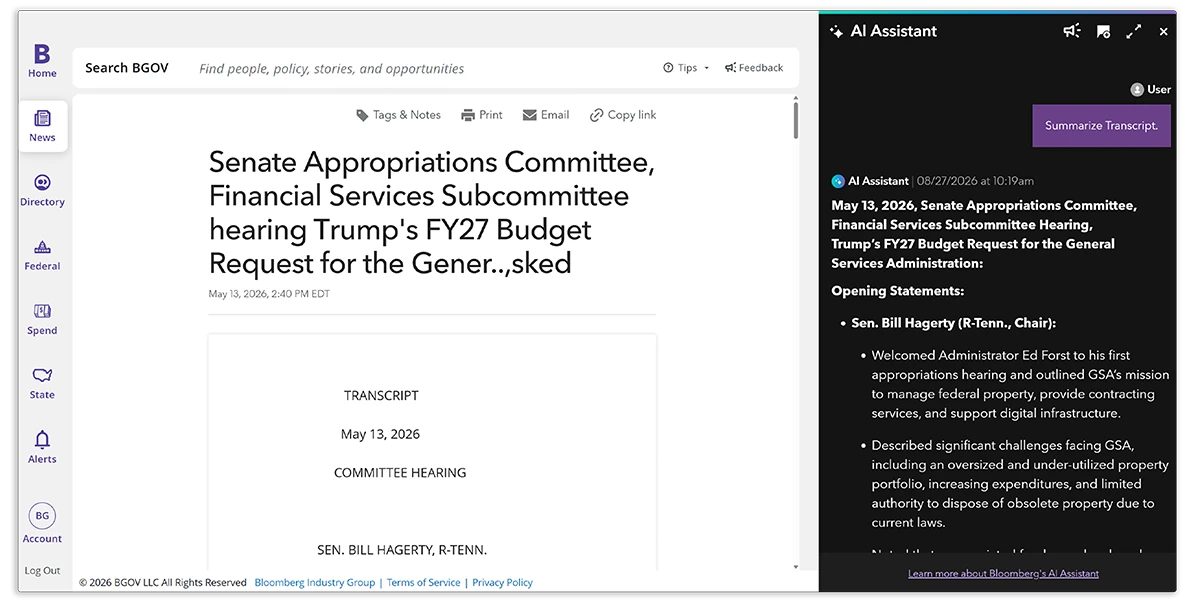
Bloomberg Government’s AI-generated hearing summaries help you quickly understand key developments and instantly surface answers from the hearing.
Funding and spending intelligence
AI built for public affairs work also can provide actionable information on funding and spending activities.
Bloomberg Government’s Spend Insights brings data from budgets, appropriations, spending, and contracting into one AI-powered experience.
Users can ask natural-language questions to uncover funding priorities, spending trends, and emerging opportunities without manually connecting information across multiple sources.
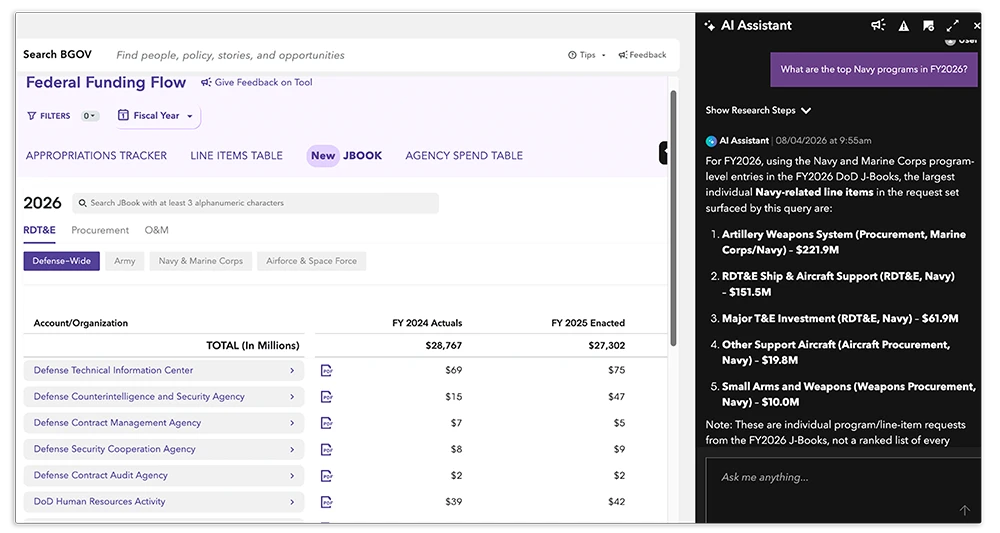
Bloomberg Government’s AI-powered Spend Insights eliminates manual research and answers questions related to defense, appropriations, and government contracting.
Enhanced federal funding data, including Defense Justification Books, provides earlier visibility into Department of Defense funding priorities.
This can help government affairs teams understand how policy decisions translate into agency spending and make more informed advocacy and business decisions.
Compliance and regulatory risk
As the volume and complexity of communications and data continue to grow, government affairs professionals and their colleagues in compliance can help ensure their organizations’ and clients’ adhere to regulatory shifts with the help of powerful and trusted AI for government affairs.
These teams can use AI to identify the real signals of change or reduce blind spots around compliance and risk and enable smarter and faster decisions.
Stakeholder and legislator intelligence
Capitol Hill is notorious for its turnover, and state-level staff can shift as well. Instead of manually paging through potentially out-of-date address books or otherwise trying to track down contacts, government affairs professionals can leverage access federal and state directories that allow them to identify, research, and engage with key players, including elected officials and lawmakers.
Bloomberg Government’s AI allows users to ask natural-language questions about Members of Congress, congressional staff, and policy issue alignment.
It identifies relevant stakeholders, surfaces networks of influence and alignment across key issues, and generates engagement-ready summaries that can be exported to PDF.
Strategic communications and briefings
When writing an effective policy brief, teams must gather and understand key facts, supporting data, political challenges, and competing interests.
For years, this meant manually researching late-breaking and overlapping political happenings, sorting through statistics, or reviewing hundreds of pages of state or federal legislation.
AI can accelerate this work by identifying key points and producing concise, accurate summaries.
For meeting preparation, fly-ins, and executive briefings, Bloomberg Government’s AI can also turn stakeholder research, policy alignment, and influence data into concise, engagement-ready summaries, reducing the time teams spend manually assembling briefing materials.
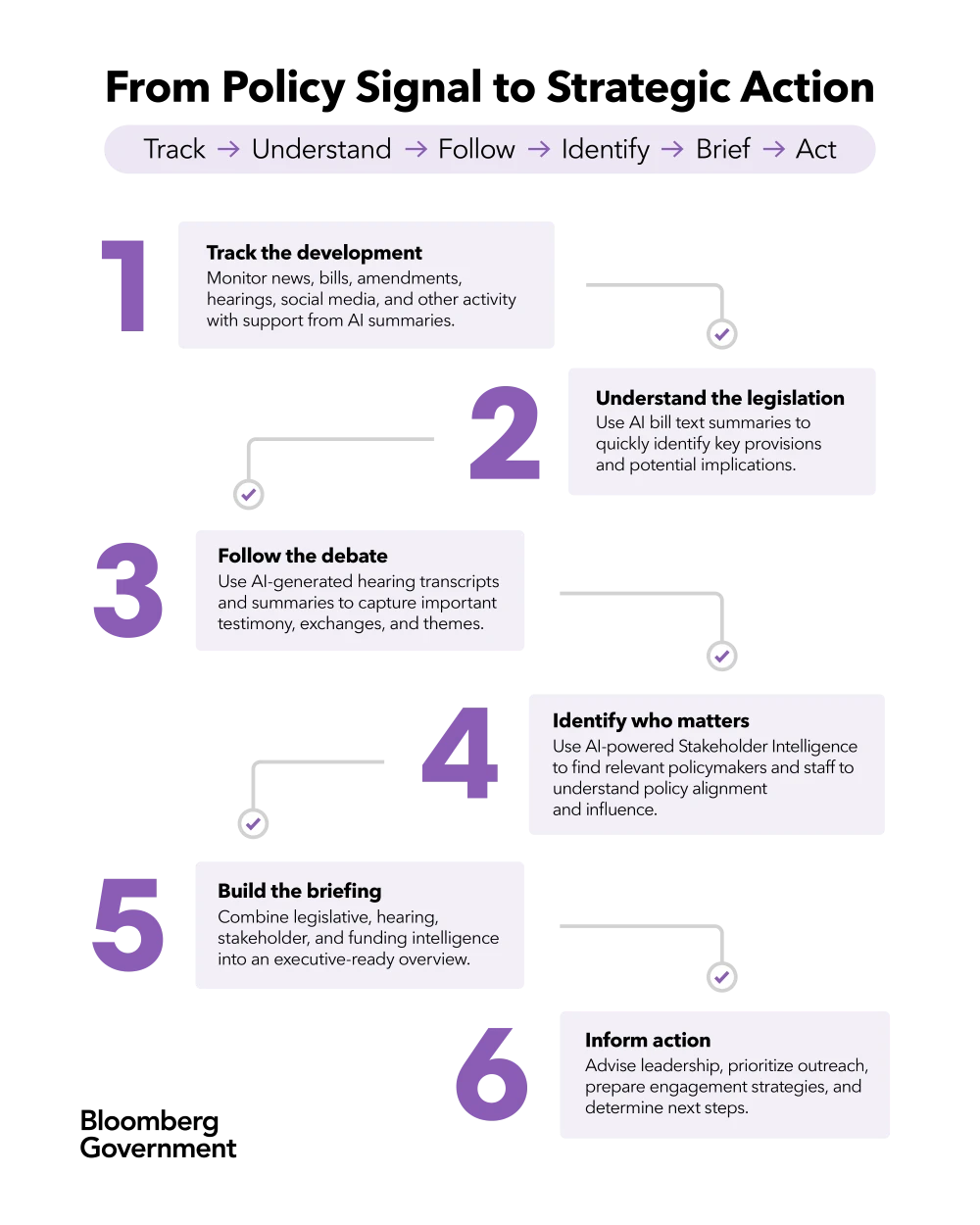
How to build an efficient AI-powered government workflow that holds up
Now that you know how AI can fit into government affairs functions, it’s important to understand whether the tool that you’re eyeing – or already using – is the best choice for you and your team. There are a few qualities and features to consider.
Data quality determines everything downstream
When evaluating or using an AI tool, it’s important to consider its data sources, because the overall quality of every AI output depends on its input – and what it runs on.
Verified legislative, regulatory, and directory data produce trustworthy summaries and alerts. General information that’s sourced from the open web, however, is neither reliable nor trustworthy.
An early question to ask when evaluating an AI tool is: Where does the AI get its information, and can you trace its summaries back to the source documents?
Cover federal and state in one place
Teams that work across jurisdictions cannot afford the time it takes to stitch together separate tools for federal and state matters. A fractured government affairs workflow that requires this kind of switching between platforms breaks down under high volume or when time is short.
An efficient AI-powered government affairs tool includes the ability to track both federal and state issues, and also helps spot issue spillover, tracks similar bills that are moving across different states, and prioritizes multi-jurisdiction activity before it escalates.
Connect functions instead of stacking point tools
Single-purpose AI tools – which also are called “point solutions,” “point tools,” or “AI-only tools” – are narrow applications that excel at one specific task in a silo but do not have the ability to seamlessly connect with other systems.
These point tools only handle certain functions, such as bill tracking but not stakeholder data, or briefings but not advocacy, and create handoff gaps.
The strongest and most effective AI for government relations connects various government affairs functions on one trustworthy platform, including policy intelligence, stakeholder research, communications, and advocacy, so nothing falls between the cracks.
Bloomberg Government’s comprehensive platform with embedded AI functionality supports connected stages of the same government affairs workflow.
It connects two questions government affairs teams frequently need to answer:
- What policy or funding development matters to our business?
- Who should we engage about it?
What AI doesn’t replace in government relations
Trustworthy AI is a necessary tool for even the savviest government affairs professionals because of its ability to help people work more efficiently.
While a trusted AI tool – with appropriate human oversight – can and should handle volume, pattern recognition, and first-pass drafting, it’s not appropriate for all professional functions.
Activities such as strategic decision-making, relationship development and judgment, and issue and project sign-off should stay with the capable humans on your team.
Ideally you can look for an AI platform that offers verified policy intelligence for government affairs professionals. After you secure the right software, build review checkpoints into your workflow and ensure human subject matter specialists review and refine the tool’s outputs.
How to minimize AI risks for government relations functions
While the use of AI has transformed how professionals across various industries are working – including in government affairs – this evolving technology carries real risks.
General-purpose AI tools can be especially dangerous for government affairs professionals because of issues including potential privacy concerns, bias or hallucinations.
For instance, if you use a general-purpose tool to create a summary or transcription of an internal meeting, you can risk exposing confidential strategies or data to its system, with this data potentially being used for system training or even potentially resurfacing in future outputs.
If you use a general-purpose AI tool to sift through and summarize legislative documents, that unvetted tool could miss information that could be key for your advocacy efforts. That tool could invent false information, known as hallucinations, that could cause you or your clients reputational damage.
To avoid risks, it’s essential to use transparent AI with vetted data that’s designed for government affairs work. Always review AI outputs and have clear documentation on the sourcing.
How Bloomberg Government connects policy intelligence to action
Bloomberg Government’s AI is built on a foundation of comprehensive primary and secondary sources, award-winning unbiased news, and expert analysis. We’re committed to innovation, and we also have a solid approach for leveraging trustworthy AI in our products.
Bloomberg Government is reliable and trustworthy because it doesn’t pull from unverified web sources and never trains on your confidential inputs.
Our AI is grounded in verified legislative, regulatory, and directory data, and our collection of authoritative content is constantly expanding, including our database of bills and regulations, detailed legislative and staffer directories, and cross-industry news coverage.
For government affairs teams who need verified, source-traceable intelligence across federal and state policy, Bloomberg Government is the platform that’s purpose built to turn that intelligence into action.
Our solution helps you work more efficiently by transparently combining the following five functions into one, single platform:
- Policy analysis and updates
- Funding and spending insights
- Compliance and regulatory risk
- Stakeholder intelligence
- Strategic communications and briefings
Bloomberg Government’s automated legislative bill tracking features allow you to monitor federal and state legislative priorities as well as budgetary and policy developments.
Our policy-focused news coverage not only explains what happened but why it matters, and our AI powered people search and discovery features help you contact and influence your networks and develop effective communications and briefings.
AI-powered capabilities extend that intelligence into funding and stakeholder workflows.
Spend Insights allows users to ask natural-language questions to uncover federal funding priorities, spending trends, and emerging opportunities.
Stakeholder Intelligence helps users identify relevant Members of Congress and congressional staff, understand policy alignment and influence networks, and create engagement-ready summaries.
This trustworthy AI-powered government affairs technology can help support a variety of workflow functions.
To better understand how Bloomberg Government’s AI can elevate your own government relations work, request a demo.