How to Choose Trusted AI for Government Affairs Work
Key takeaways:
- Government affairs teams use AI to improve policy research, stakeholder engagement, and decision-making, but general-purpose tools can introduce accuracy, privacy, and bias risks.
- Trustworthy AI for public affairs relies on verified legislative and regulatory data, editorial review, source traceability, and a stable technology provider.
- Trusted government affairs AI improves efficiency in high-volume research, analysis, and pattern recognition while preserving human judgment for strategy and relationship-building.
Many government affairs professionals are using AI tools every day to conduct policy research, draft policy briefs, and find everyday efficiencies in their work.
In an election year, working fast is critical. But just as important is finding answers and analysis you can trust as the basis for your strategic decisions.
Risk arises when busy teams use AI for policy intelligence before they’ve thoroughly vetted the tools they’re using.
AI outputs are only as trustworthy as the data and expert review behind them, which means using the wrong AI tools for government relations tasks – like relying on ChatGPT for legislative research – can introduce serious risks for hard-working teams.
But here’s the good news: Government affairs professionals can limit their exposure by choosing a trustworthy AI policy intelligence platform that runs on verified legislative and regulatory data and is subject to editorial review.
In this article, learn how to determine whether an AI tool can be trusted for policy work, and which government affairs AI tools are worthy of your attention.
What makes AI trustworthy for policy intelligence
These days, it may feel like AI tools are both inescapable and essential in the workplace – especially in sectors where information is currency. While many AI tools are capable of parsing through mountains of data in seconds, some of these tools do not have the ability to complete such tasks accurately.
For instance, using ChatGPT policy analysis or relying on other general-purpose AI tools such as Gemini or CoPilot for precise government affairs work can introduce serious risks related to accuracy, privacy, and even bias.
Government affairs professionals who use AI tools in their workflows should ensure that the tech they deploy is trustworthy and purpose-built.
So, what makes AI for government affairs trustworthy? To be considered an appropriate source for policy intelligence, an AI tool should have:
- Verified source data – not data from the open web
- Editorial review to ensure accuracy
- Source traceability to make outputs explainable
- A quality standard and benchmarking for completeness
[Download A Buyer’s Guide to Artificial Intelligence Policy Software for a practical framework for evaluating AI policy software based on the factors that matter most for government affairs professionals.]
Vetted intelligence vs. general-purpose chatbots, side by side
GA and public affairs leads, it’s important to know how vetted AI for policy intelligence stacks up against ChatGPT policy analysis or other general purpose chatbots. If you regularly analyze or track policy for a corporation, association, nonprofit or lobbying firm, consider how these solutions perform in the following areas.
Data source
General-purpose AI tools are trained on the open web and respond to queries using that open data – where sourcing can be confusing, inaccurate, or completely unknown. Gaps or limitations in data can lead to harmful AI hallucinations.
Meanwhile, trustworthy policy intelligence tools include explainable AI for policy research. These outputs are based on vetted, curated, and tested legislative, regulatory, and directory data.
For example, Bloomberg Government’s AI can generate concise bill text summaries and synthesize congressional hearing transcripts while allowing users to return to the underlying source material to verify details if needed.
Recency/timeliness
One big AI risk in policy analysis? General purpose tools like mass-market chatbots built with training cut-offs, which means the AI tools may pull from antiquated sources, resulting in outputs that are outdated or inaccurate.
Trustworthy policy intelligence can leverage Retrieval-Augmented Generation (RAG) technology to pull the latest information directly from authoritative sources. In this way, trusted AI for government affairs can help ensure that its outputs are based on current, accurate information.
Purpose-built tools can also apply AI across specialized, frequently changing datasets.
For example, Bloomberg Government’s Spend Insights, available in October, uses natural-language analysis across budget, appropriations, and contract data to surface funding priorities and spending trends.
Spend Insights also incorporates defense justification books (j-books) to provide earlier visibility into Department of Defense priorities.
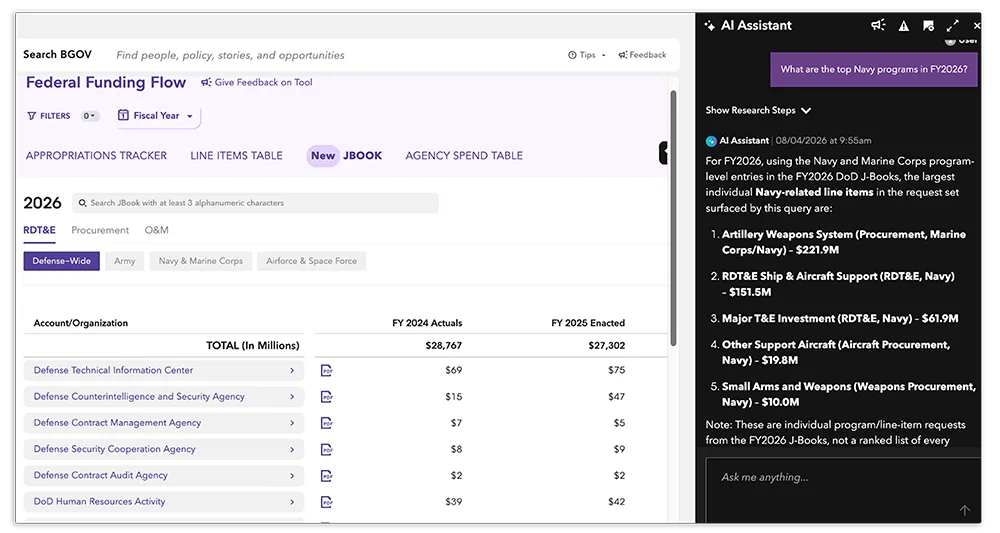
Bloomberg Government’s AI-generated hearing summaries help you quickly understand key developments and instantly surface answers from the hearing.
Source traceability
Another key AI risk in policy analysis: General purpose tools pulling from the open web, resulting in inaccurate or incomplete sourcing – or no transparent sourcing at all.
A trustworthy policy intelligence platform includes source-traceable AI that pulls from verified and authoritative legislative and regulatory sources.
Whether reviewing an AI-generated bill summary or hearing transcript summary, users should be able to verify the output against the original bill text or hearing record.
Jurisdiction coverage
If you’re using ChatGPT for legislative research, or harnessing other general-purpose AI tools for jurisdiction coverage, it’s important to understand that these tools can completely miss the latest information from specific jurisdictions.
And because general-purpose AI tools pull from the open web, their outputs are not optimized for specific jurisdictions and can lack critical nuance.
Which tool wins when comparing ChaptGPT vs a purpose-built policy intelligence platform?
The policy intelligence platform – especially when it can be tailored to specific jurisdictions and optimized to reflect the nuance of both federal and state matters, with filters for fast and precise searching.
Editorial rigor
General-purpose AI tools that are trained on the open web can deliver outputs that lack vetting by expert sources.
Purpose-built AI for public affairs delivers high quality, trustworthy outputs based on authoritative and expert-reviewed content. These AI tools for lobbyists often include benchmarking as part of their vetting process.
Vendor stability
A variety of new tech tools are emerging on the market as investors toss billions of dollars into the AI race. Some of these flashy mass-market tools can lack stability and reliability, which means they could be here today and gone tomorrow – along with your data.
When selecting an AI tool that you can rely on for years to come, it’s best to seek out a vendor that has a history of dependability, a dedication to quality, and strong track record of stellar customer service.
How to evaluate AI for policy intelligence
Think of general purpose tools like you’d think of public parks: Anyone is welcome to use them, run around without supervision, and bring all manner of accouterments (think unvetted and nonspecific data).
Meanwhile, trustworthy AI functions more like a private dinner party: Special guests are invited (think vetted and authoritative data), with hosts (aka human experts) monitoring the event so it proceeds according to previously set parameters.
To ensure that you’re in a private dinner party situation instead of a free-for-all visit to a public park, consider asking the following questions about any AI tool you’re considering for government affairs work.
Before you invest, confirm that any tool for government relations work would be permitted for use within your organization’s AI governance framework.
Checklist for evaluating any AI for policy intelligence:
◻ Does the tool source from current, verified legislative, regulatory and directory data and not the open web?
◻ Does the tool incorporate editorial review by human experts to ensure the AI remains accurate?
◻ Does the tool feature source-traceable AI that allows you to follow the tool’s summaries and other information back to the source documents?
◻ Does the tool measure its outputs against an established benchmarking standard to ensure accuracy and completeness?
◻ Does the tool offer AI-powered stakeholder analysis to identify relevant policymakers, staff, policy alignment, and influence networks?
Trusted AI does not replace human judgment
Trustworthy AI tools that include explainable AI for policy research can help government affairs professionals work more efficiently and strategically. But these tools, while capable, should not be used for all workplace tasks.
With respect to government affairs workflows, trusted AI with verified sources – and appropriate human oversight – can handle tasks that require volume, pattern recognition, and first-pass drafting.
However, strategic decisions, relationship development and judgment, and task and project sign-offs should stay with the humans on your team.
When using a trusted policy intelligence platform in your workflows, plan to build in human review checkpoints and treat AI generated outputs as the start to your work – not the conclusion.
When Bloomberg Government is the right fit
Bloomberg Government’s AI is built on a foundation of comprehensive primary and secondary sources, award-winning unbiased news, and expert analysis.
Our collection of authoritative content is constantly expanding, including our database of bills and regulations, detailed legislative and staffer directories, legislative tracking software with AI, and cross-industry news coverage.
Our AI-enabled tools train on this authoritative content, making our policy intelligence platform reliable and trustworthy because it is grounded in verified legislative, regulatory, and directory data.
For government affairs teams that need vetted, source-traceable AI across federal and state policy, Bloomberg Government is purpose built to turn intelligence into action.
Our all-in-one solution for government relations help teams work more efficiently by combining:
- Verified legislative and regulatory data across federal and states
- AI-powered bill text summaries, hearing transcripts, and transcript summaries
- Spend Insights for analysis across funding, appropriations, contracting, and defense spending data
- Comprehensive directories and AI-powered stakeholder intelligence for identifying policymakers, staff, policy alignment, and influence networks
- AI supported by editorial review and transparent methodology
Want to learn more about how to use Bloomberg Government to work more efficiently and take action on vetted policy intelligence? Request a demo.