Multistate Legislative Tracking: An AI-Powered Workflow
Key takeaways:
- Multistate legislative tracking helps government affairs teams monitor proposals across all 50 jurisdictions and identify opportunities to shape policy before key decisions.
- AI-assisted bill summaries and cross-state text comparisons accelerate research, helping teams proactively investigate policy differences and identify provisions to support or amend.
- Prioritize engagement by weighing organizational impact, legislative momentum, upcoming decision points, and the team’s ability to influence the outcome.
- Bloomberg Government brings state legislative tracking, AI-assisted research, reporting, directories, and collaboration tools into one platform, helping teams maintain continuity from monitoring through advocacy.
For lobbying and government affairs teams, a multistate legislative tracking strategy supports both preparing for change and proactively shaping change. Executing this strategy, however, means following policy interests across several state legislatures, each with its own procedures, terminology, calendars, and political relationships.
A government affairs professional might cover five priority states or all 50, depending on where the organization operates and where relevant policy ideas are emerging. Monitoring requires navigating distinct state and local environments, meaning the complexity compounds quickly.
In this fragmented landscape, lean government affairs teams must nonetheless maintain a unified approach: tracking developments across jurisdictions, spotting opportunities to shape policy, mitigating risk, and acting before critical windows for influence close for good.
At its core, the challenge is one of allocation. No team can treat every development in every state as equally significant; instead, they must decide where to put their time, attention, and resources.
Meeting that challenge requires more than a flood of state-by-state alerts. It requires a repeatable workflow across states to decide where to invest influence across several moving legislative processes.
Building a Proactive Multistate Legislative Tracking Workflow
To effectively identify opportunities to shape policy, government affairs teams need early visibility into the relevant legislation.
Consider a team tracking data center policy across several states: the task is not simply to monitor activity, but to quickly determine how changes impact their priorities, messaging, and outreach as proposals evolve across states.
One state might propose tax incentives for new facilities, while another considers requirements for energy or water use. The team needs to compare which facilities each proposal covers, assess the implications for planned investments, and identify provisions it could help shape before they advance.
An amendment can change that engagement plan. If an incentive bill adds an eligibility restriction, the team must quickly determine which projects could be excluded, revise its talking points, and decide whether to seek changes through the sponsor or relevant committee members.
A multistate legislative tracking workflow connects early monitoring with ongoing analysis and timely outreach. The work falls into six phases, with technology helping teams investigate developments faster and coordinate their next steps:
-
Find relevant state legislation with targeted searches and alerts
Navigating 50 jurisdictions means sifting through volume with precision. Broad searches generate noise, while narrow searches can miss developments. Teams need to monitor their priority states while watching for ideas emerging elsewhere.
For most government affairs professionals, assembling the right information can mean moving among disparate state websites and other sources, increasing context switching and repeating discovery.
Bloomberg Government brings all this information under one state legislative tracking software, giving teams a shared starting point. State bill search, legislative alerts, custom state news alerts, and heatmaps help teams find relevant activity and see where related proposals are appearing.
A team tracking data-center policy, for example, might begin with a broad search for energy use. If the immediate concern is the Upper Midwest, Bloomberg Government’s state filter or interactive map can narrow results geographically. Teams can refine the search by legislative session and bill activity, including committee action, passage in the House or Senate, and conference reports. The same search-and-filter approach informs proposed and adopted rules.
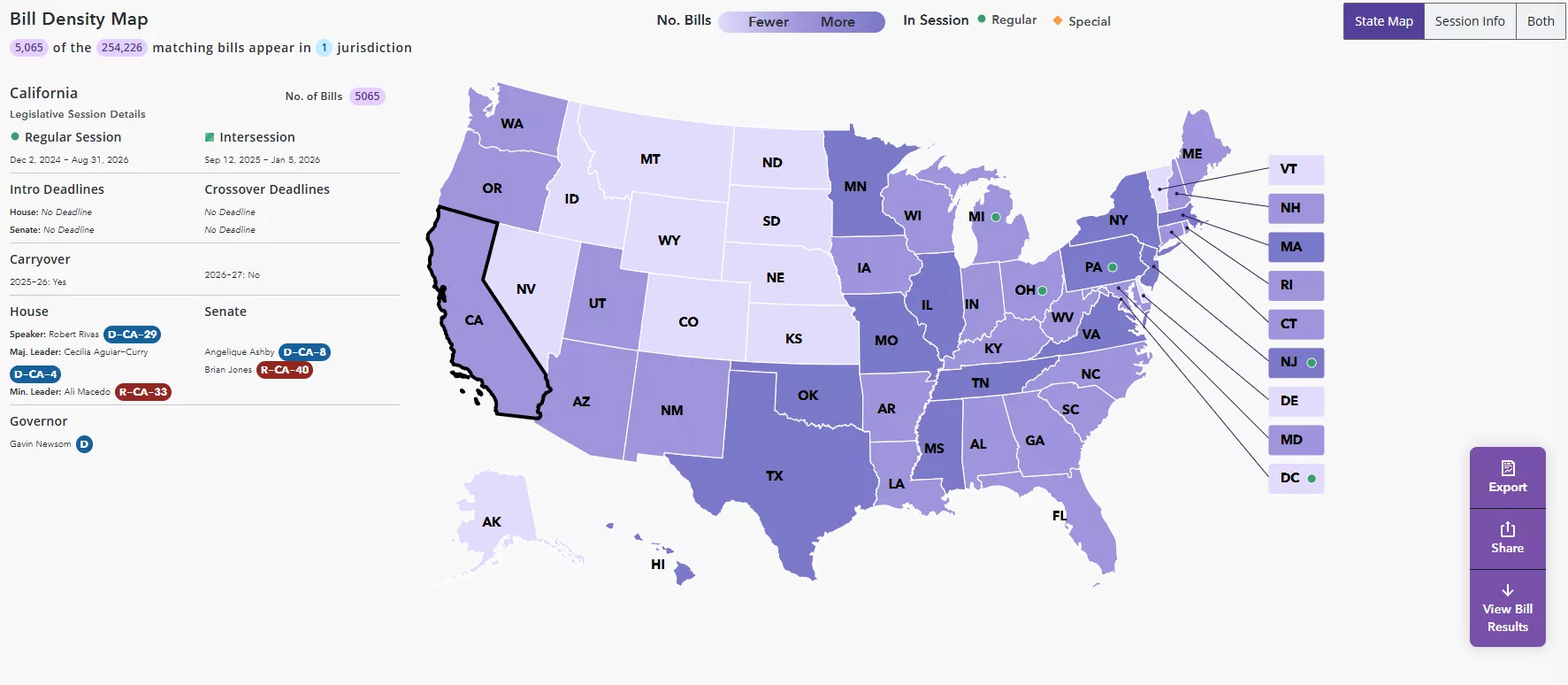
Heatmaps visualize legislation being considered across the country to identify opportunities and threats to policy initiatives.
Karina Taylor, senior product manager at Bloomberg Government, says, “We really believe this to be the best partner in building your multistate strategy. You’re going to be able to see policy move across jurisdictions to inform the deployment of your time, your attention, and your resources.”
[ To learn more about how to set custom alerts and collaborate with your team on tracking bill activity across all 50 states, watch our Powering Your State Strategy with AI webinar on-demand. ]
-
Understand bill changes and their policy implications
Once a team identifies relevant activity, it needs to assess what a development means, and whether there is an opportunity to wield influence. Bill summaries, bill text, status information, and state reporting help establish what happened, with AI-assisted summaries accelerating the initial review process.
In the data-center example, teams can review where a measure sits in the legislative process – such as whether it remains in committee – with that status visible in Bloomberg Government. On the regulatory side, teams can similarly review comment deadlines and effective dates.
However, status alone is not helpful for understanding the implications of advancement. Rather than working through hundreds, if not, thousands, of pages of bill text, teams can use Bloomberg Government’s on-demand AI bill summaries to understand what any given bill is about and what policies might be impacted if it were enacted. The AI Assistant for state legislative tracking is available on every state bill in the platform – with links back to the original bill text – enabling government affairs teams to move earlier and move faster.
See how Bloomberg Government’s on-demand AI bill summaries help government affairs teams review state legislation faster, with access to original bill text for verification.
-
Compare legislation across states to inform your strategy
Understanding what a development would do is only part of the job. Teams must also review how other states are addressing the issue—and where differences could affect their interests, such as language they could support, provisions they might seek to amend, or approaches worth proposing elsewhere.
Establishing this broader context can be difficult, though, especially as baseline definitions may vary from one state to the next. With data-center policy, for example, one state’s definition may not align with another’s, changing how similar-looking proposals would operate in practice.
Bloomberg Government’s AI-powered state bill comparison supports teams with finding similar legislative language across jurisdictions, including from sample or model text. Match scores evaluate how closely language aligns, and exportable comparison results support further review and discussion with stakeholders. Using this, a team could, say, compare a Minnesota provision defining energy-generation redundancy with related language in measures from other states.
By comparing specific provisions across states, teams can identify language to advocate for and adapt their approach to each state’s policy context.
-
Prioritize opportunities to shape state policy
Once teams understand how states are treating an issue, teams must connect what is at stake with where their involvement could make a difference. Government affairs professionals also need to be precise in when and how they choose to act.
For instance, a high-impact bill may have little chance of advancing, while a narrower proposal may offer an immediate opening. To prioritize opportunities, teams are actively evaluating:
- Business exposure: Which operations, investments, customers, or members would the proposal affect? How significant is the impact, and does it advance or undermine an organizational priority?
- Legislative momentum: Is the bill receiving hearings, gaining sponsors, or attracting leadership support? Did similar proposals advance previously?
- Timing: What is the next decision point, and can the team act before it? A hearing, amendment deadline, or committee vote may create a specific opportunity to contribute.
- Ability to influence: Does the team have relevant relationships, credible evidence, or potential coalition partners? Is there a specific change it can reasonably ask policymakers to make?
These factors are important to weigh against one another because most teams are not just reacting to changes but looking to proactively influence these state-level policies before they actually go into effect. Knowing when to react versus when to take initiative comes down to understanding all the players involved in shaping change.
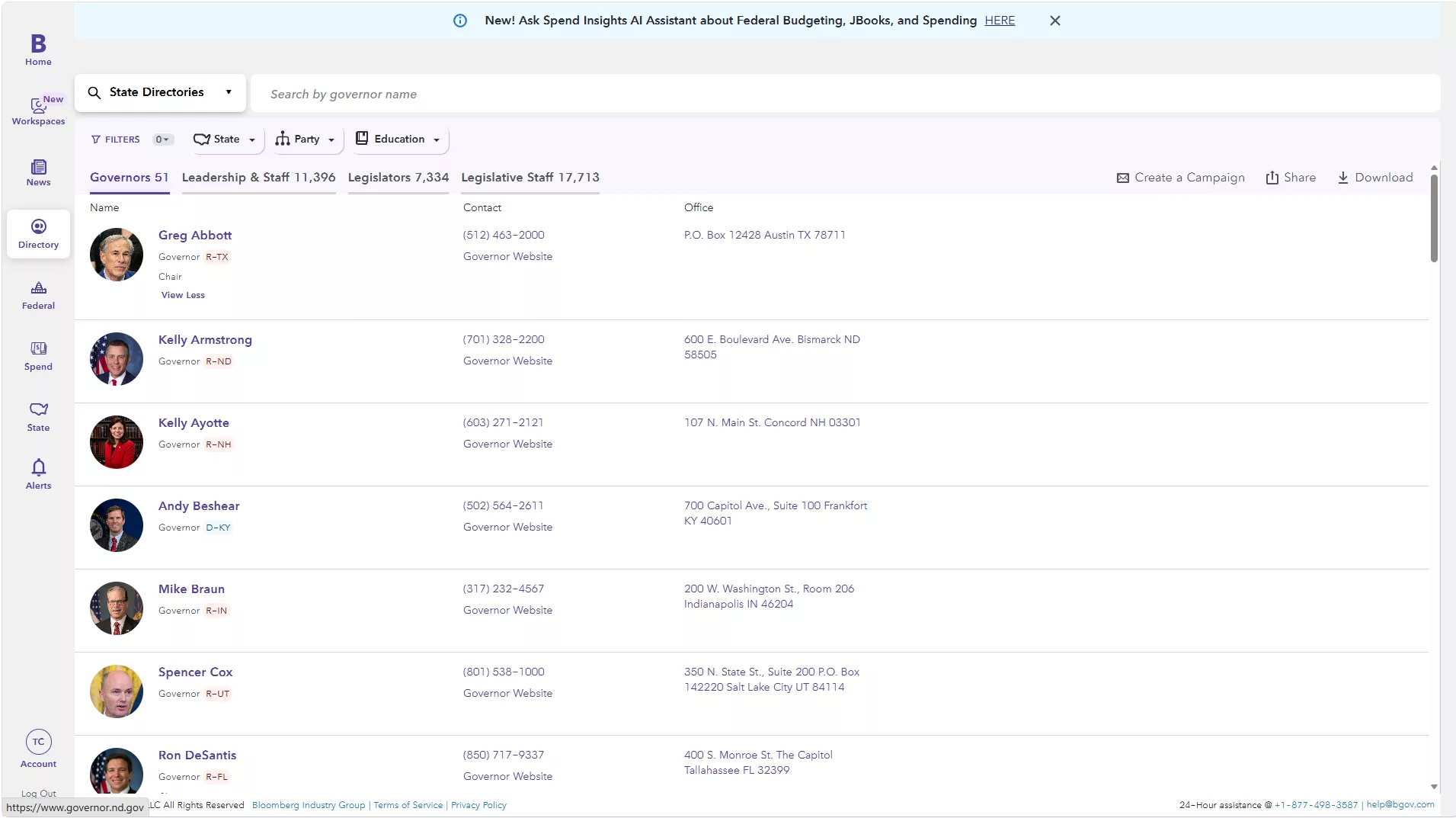
Identify state decision-makers relevant to your policy priorities and use state directories to inform your legislative outreach.
-
Identify key state decision makers and time your outreach
Once teams determine which developments warrant engagement, the next question is whom to reach – and when. Each state brings a different set of sponsors, committees, staff, and potential partners. Teams must choose where their time and relationships can make the greatest difference.
For a team tracking data-center policy, for example, relevant contacts can span governors and executive staff, legislators and legislative staff, and drafting experts. With Bloomberg Government’s state directories, teams can filter by state, role, or committee, with background and contact information updated at a near-daily pace. Directories also include issue areas and committee assignments, further helping teams identify relevant stakeholders.
Sarah Polger, senior product manager for Bloomberg Government, says “You can quickly export all this contact information in an Excel doc, so that it either incorporates into the workflows within your own teams or you save it if it’s something you want to revisit [in] the future.” You can see how policy is actively moving along in its process as well as who are the people influencing those decisions and shaping that policy itself.
Session timelines and legislative status also help teams plan engagement around the process. Before the ink dries on legislation, hearings and other legislative events offer opportunities for influence. If a data-center measure is headed for a committee hearing, for example, the state events calendar can help teams plan outreach.
Connecting state directories with legislative timing helps teams focus their outreach on the people who can shape a proposal while changes are still possible.
-
Track legislative changes and adapt your engagement strategy
Once teams identify whom to engage and when, the next challenge is staying current as the policy landscape shifts – no small feat, as state legislatures move on different timelines.
For a team tracking data-center policy, for example, an amendment could change the organization’s position entirely or make a lower-priority bill suddenly urgent. When that shift happens, teams must preserve earlier reasoning, coordinate follow-up, and reassess related bills as developments unfold without reconstructing previous work from scratch.
The ever-evolving nature of multistate legislative tracking is exactly what makes a repeatable workflow essential. Bloomberg Government pulls together each step of the tracking process in one platform, including collaborative tools that support continued monitoring across team members.
- Shared notes and tags, My Meeting Notes, and assigned follow-up help colleagues retain context and coordinate their next actions
- Workspaces gives your team a shared environment for organizing intelligence around the issues, clients, programs, and priorities that matter most
- Exported status reports retain historical and institutional knowledge behind earlier priorities
- Saved-search alerts surface new activity around issues already being tracked, delivered at a preferred cadence—allowing teams to “set it and forget it”
The payoff is continuity. Teams can return to earlier research as developments evolve, rather than having to rediscover the issue all over again and rebuild earlier work from a blank slate.
Strengthen Your Multistate Legislative Tracking and Advocacy Strategy
State-level policymaking is moving faster than ever, requiring government affairs professionals to be agile, proactive, and data-driven. Effective multistate legislative tracking helps government affairs teams identify opportunities to shape policy and adjust their outreach as proposals change.
A connected legislative tracking workflow keeps bill comparisons, stakeholder information, and prior research accessible, so each development informs the next decision.
Bloomberg Government brings state legislative tracking, AI-powered bill comparison, expert reporting, and policymaker directories into one platform. Teams can investigate policy differences across states, identify relevant decisionmakers, and prepare for engagement before key legislative decisions.
Request a demo to see how Bloomberg Government helps your team track state legislation and identify opportunities to influence policy.