Key takeaways:
- Tracking federal contract opportunities requires combining procurement notices with funding evidence, agency buying patterns, incumbent research, and policy developments to assess which pursuits warrant investment.
- Budget requests and agency forecasts signal potential demand; neither guarantees a solicitation or confirms funding availability for a specific procurement.
- Historical contract obligations and incumbent records help teams assess purchasing patterns and potential follow-on work; award ceilings and expiration dates alone provide insufficient evidence.
- Policy and appropriations developments can change an opportunity’s scope, timing, or funding outlook, requiring teams to revisit pursuit assumptions.
- Bloomberg Government connects opportunity research with funding, spending, and policy intelligence, helping teams collaborate in a shared workspace to inform capture decisions.
Business development and capture teams track federal contract opportunities through SAM.gov notices, agency procurement forecasts, historical award data, and commercial intelligence platforms. They organize selected opportunities in a CRM or pipeline tracker and update their pursuit decisions as new information becomes available.
Monitoring procurement notices on SAM.gov is one part of the tracking process. A notice describes a requirement, but it may not provide enough context about funding, incumbent companies, spending trends, or policies driving the need for the work. This research helps determine which contracts are within a company’s capabilities and are worth pursuing.
This guide explains how to build that context around an opportunity, identify research bottlenecks, and connect the findings to capture decisions. It also shows how Bloomberg Government brings spending and policy intelligence into the same, consolidated workflow.
The problem with most government contract tracking setups
Disconnected research systems can create bottlenecks for business development and capture teams tracking federal government contracting opportunities.
Government databases provide authoritative procurement and award information at no cost. Established teams often supplement those records with commercial platforms, customer knowledge, and shared pipeline trackers. The remaining work is connecting each opportunity to the funding, buying patterns, and policy developments that affect its outlook.
Finding the right opportunities quickly and efficiently is critical to building successful pipelines and winning federal contracts. A relevant notice is a starting point; deciding whether to invest capture resources requires a wider assessment.
For example, a forecast may indicate a planned purchase while budget documents still show only requested funding. An existing award may identify a likely incumbent without confirming whether the agency will recompete the same scope. These gaps make it harder to assign a realistic pursuit stage and next action.
Bloomberg Government offers a comprehensive solution that connects upcoming opportunities and contract data with agency budgets, appropriations, policy developments, and Bloomberg Government news, helping teams understand what is driving an opportunity and how it fits into broader government priorities.
How to build context around federal contract opportunities
Business development and capture teams must thoroughly vet federal contract opportunities to understand if their company aligns with the target agency’s mission. They also need to assess eligibility, access to the purchasing vehicle, and whether the evidence supports investing in capture.
While SAM.gov and other government websites provide essential source records, business development teams still must conduct further research to arrive at the answers they need to take confident action.
Know what is driving the opportunity
Understanding the pressures on the federal budget alongside what a given agency is trying to achieve helps business development and capture teams assess how their capabilities fit the work.
While data and history are important to track, so are current events and trends. An executive order, new presidential policy directive or a new law can significantly impact the federal contracting landscape.
A larger agency budget does not necessarily mean more addressable contract spending in your market. Check the relevant program documents, procurement plans, and past purchases to determine how the priority could translate into work your company can pursue.
Bloomberg Government provides real-time policy analysis and combines legislative tracking, market intelligence, budget analysis and procurement data into a single workspace.
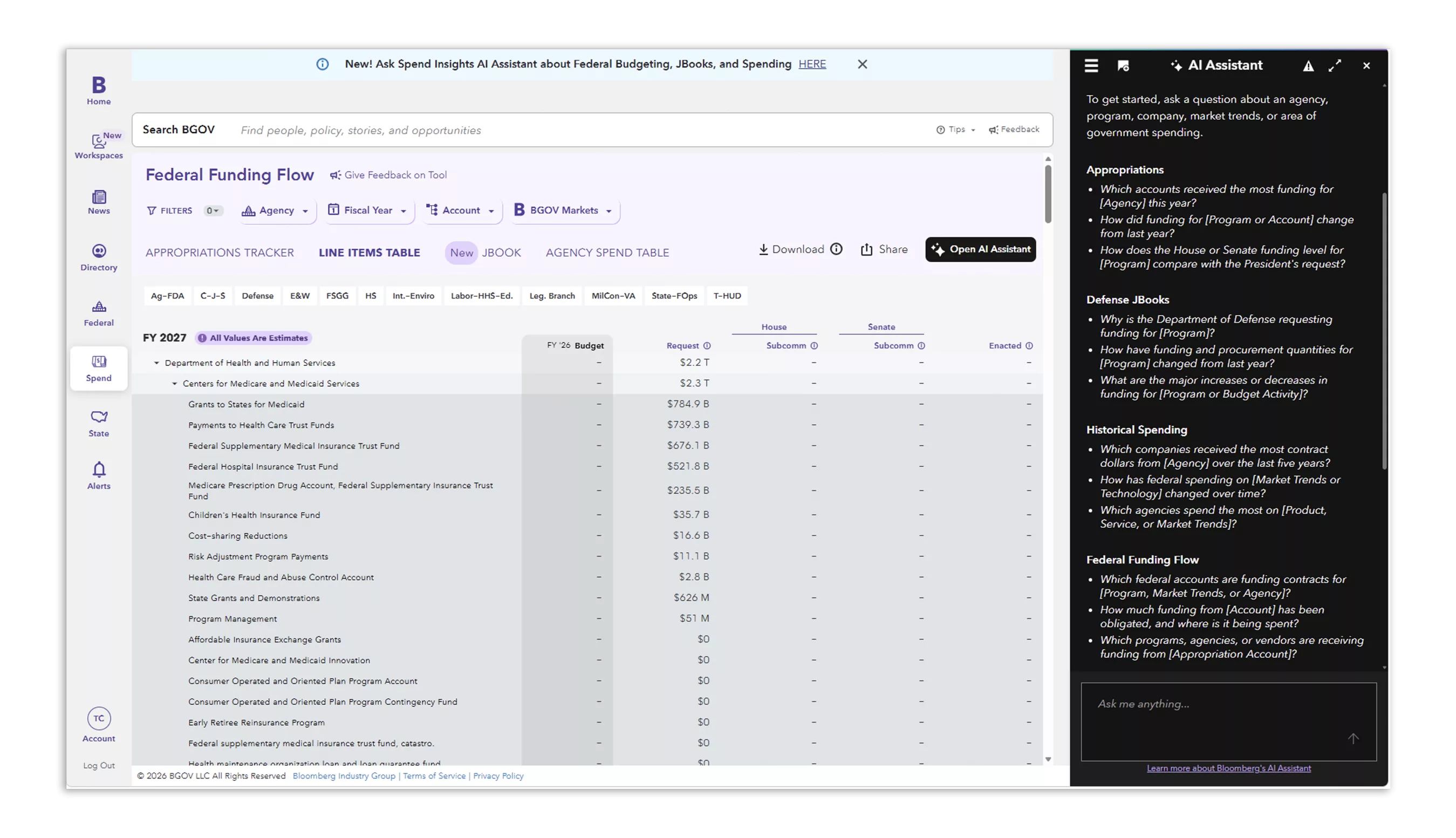
Explore incumbents and agency funding patterns with AI Assistant prompts in Bloomberg Government’s Federal Funding Flow to inform federal contract opportunity research.
Where the opportunity sits in the funding lifecycle
Knowing the federal budget process helps leaders assess uncertainty and allocate business development resources.
DoD Defense Justification Books (JBOOKS) explain requested program funding and its rationale. Bloomberg Government incorporates this defense budget information into its Spend Insights experience, giving teams earlier context on program priorities before a solicitation appears.
That being said, funding for a broader program does not, by itself, establish that money is available for a particular procurement. Check the solicitation and amendments for funding conditions, including an Availability of Funds clause where applicable, and seek clarification from the contracting officer when needed.
Use the distinction to set the next action right in Bloomberg Government with Workspaces. Teams can save supported content in a shared folder and add notes about a proposed investment, an enacted program’s procurement plans, or their evaluation of a published requirement against the company’s capture criteria. This shared context helps colleagues build on one another’s research and coordinate action as funding decisions evolve.
Agency buying patterns and funding trajectories
Mapping government priorities and spending patterns allows decisionmakers to uncover spending trends and identify future opportunities early.
Review historical spending by agency or subagency, type of work, vendor, and purchasing vehicle. A large award ceiling can overstate the business available if actual obligations remain low; a single spending spike may reflect a one-time purchase.
Compare those patterns with agency procurement forecasts and current funding evidence. Sustained demand in a market the company can access may justify capture investment. A one-off purchase or uncertain follow-on plan may warrant continued monitoring. Forecasts are planning tools and can change or be canceled.
Understanding incumbent activity
Research the current awardee, contract scope, reported obligations, modifications, and potential expiration or option dates to assess a follow-on opportunity. Knowing what company currently holds a public-sector contract is only one piece of information.
Understanding how the incumbent company is performing for the government and when its contract expires is critical knowledge to shape winning bids. Check whether the agency expects to retain the scope, use the same purchasing vehicle, or change the acquisition approach. An approaching contract end date is a reason to investigate; it does not confirm that the agency will hold a new competition.
Unseating an incumbent business is difficult unless a company can show a clear performance or cost advantage. Bloomberg Government’s historical spending and company profiles help teams investigate incumbent contracting portfolios and identify potential competitors or partners to make better informed decisions around pursuing directly, exploring teaming, or gathering more customer information before committing resources.
How government action can change the outlook
Policy and appropriations developments can change an opportunity’s scope, timing, or funding outlook after it enters the pipeline. Executive orders, legislation, budget appropriations, and political policy shifts can fundamentally reshape the assumptions behind a pursuit.
Government priorities can shift significantly between a proposed budget and actual spending, making it difficult to see which initiatives are gaining momentum and where opportunities may emerge.
For example, a continuing resolution can create funding or planning constraints that warrant a timing review. Business development teams should compare new developments with the assumptions recorded against affected pursuits, then update the next action and review date. Bloomberg Government combines legislative and regulatory tracking with appropriations coverage, expert analysis, and news to support that assessment.
One capture decision before and after Bloomberg Government
Consider a capture team asking: Is this anticipated recompete worth investing in now? Answering that question today usually means logging into separate award databases, pulling funding documents from another system, and asking a colleague in government affairs to check recent legislative activity — with no shared program ID connecting any of it.
- Business development owns the award and notice research
- Government affairs owns appropriations and policy
- The forecast check often belongs to no one in particular.
The result: the same question gets answered by hand, every time, across teams that aren’t working from the same picture. Moving opportunity research into Bloomberg Government reduces the work of reconciling award records, funding documents, and policy developments across separate systems.
Business development and capture teams can investigate incumbents and agency buying patterns alongside budget requests, appropriations, and procurement information to assess whether a pursuit warrants investment. Legislative tracking and Bloomberg Government news help teams identify developments that could change its scope or timing, while Workspaces preserves supported BGOV content and shared notes for capture reviews.
Together, these capabilities help teams spend less time assembling context and give colleagues a clearer basis for reviewing pursuit recommendations.
Intelligent federal contract opportunity tracking with Bloomberg Government
Bloomberg Government connects opportunity research with funding and policy intelligence to help business development and capture teams decide which pursuits deserve investment.
Research agency buying patterns and incumbents, then use Federal Funding Flow to investigate budget requests, appropriations, and spending. Defense justification books add earlier context on program priorities, while legislative tracking and Bloomberg Government news help teams assess changes to a pursuit’s outlook.
AI-powered Spend Insights accelerates research across spending data. Workspaces lets teams organize supported BGOV content and shared notes around a pursuit, preserving context for capture reviews.
Request a demo to see the workflow in action.
Frequently asked questions
Review the solicitation and amendments for funding conditions, then examine relevant enacted appropriations and agency information. A budget request shows proposed funding; an appropriation for a program does not establish funding availability for a specific contract. Ask the contracting officer for clarification where needed.
Research the requirements, eligibility conditions, purchasing vehicle, funding status, incumbent, agency buying patterns, and policy developments. Compare the findings with your company’s delivery capacity and competitive position before committing proposal resources.
Federal contractors need agency procurement forecasts, budget justifications, enacted appropriations, and policy developments alongside historical award data. Bloomberg Government connects funding, spending, and policy intelligence with opportunity and company research, helping teams assess agency priorities, investigate incumbents, and decide which pursuits warrant investment.
There is no fixed lead time. Budget requests, procurement forecasts, and agency engagement can reveal potential requirements months or longer before a solicitation. The timing varies, and an early signal does not guarantee that a procurement will proceed.
Search SAM.gov Contract Awards or USAspending.gov using the existing contract number, agency, or requirement description. Review the awardee and contract modifications, and check whether the record covers the same work as the anticipated opportunity. Bloomberg Government’s company profiles and historical spending tools support further competitive research.
Yes. Legislation, appropriations decisions, and agency actions can affect the assumptions behind a posted opportunity. Monitor official amendments for procurement changes and reassess the pursuit when relevant funding or policy developments change its outlook.