Key takeaways:
- DoD J-Books explain requested program funding and its rationale. They provide early demand signals, but cannot confirm future solicitations or contract awards.
- To read a J-Book, locate the relevant program, compare funding and available quantities across years, then review the justification and schedule.
- Contractors should follow promising budget signals through appropriations and agency acquisition activity before committing substantial capture resources.
- Bloomberg Government connects budget requests, appropriations, and spending outcomes through Federal Funding Flow. Spend Insights supports natural-language research across budget and contracting intelligence.
Department of Defense budget justifications books, commonly called J-Books, help contractors investigate DoD priorities early. They explain what the DoD wants Congress to fund and why, making them a key tool for tracking federal funding flow.
Using them starts with a practical question: Does a proposed investment point to a need your company can meet? Arriving at an answer requires reading the relevant budget lines, assessing the evidence, and following a potential opportunity as funding and acquisition plans develop.
While DoD J-Books are publicly available to surface this information, they’re not exactly easy for the public to use. The volumes are published as hundreds of inconsistent and dense PDFs. When teams are facing limited time to assess a program and prepare a competitive response, bypassing the time-consuming and tedious manual process of sifting through jbooks is essential to making quick, informed decisions about advocacy priorities.
Read on to gain a deeper understanding of justification books – why they matter for federal contractors and government affairs professionals, and how you can more easily access them via Bloomberg Government’s integrated platform.
What are defense justification books (J-Books)?
What are J-Books, exactly? They are budget justification books that explain what DoD is asking Congress to fund. Contents typically include:
- Detailed financial and programmatic documents
- Descriptions, schedules, and technical goals for individual military systems and efforts
- Multi-year funding data spanning past, current, and future fiscal years
- Exact numbers of units, missiles, aircraft, or capabilities being purchased
- Tracking codes for research, development, and procurement lines
All of this is submitted to the House and Senate appropriations subcommittees to explain, itemize, and defend the administration’s request for military funding.
J-Books are organized by military department or Defense agency and appropriation account – such as Procurement, RDT&E, Operation & Maintenance, MILCON, or revolving funds – and are especially useful for government contractors as a market-intelligence, capture, and account-planning resource.
J-Books existed for decades as physical records. Today, these volumes are digital. In recent years, government affairs professionals, lobbyists, and contractors have had to access these dense PDFs via a time-consuming and tedious process that involves cross-referencing disconnected sources, toggling between spreadsheets, and combing through the Under Secretary of Defense Budget Materials website (aka the Comptroller site) to answer questions.
Without a tool that provides integrated access to J-Books, it can be difficult to track federal spending decisions and efficiently connect these decisions to likely policy outcomes.
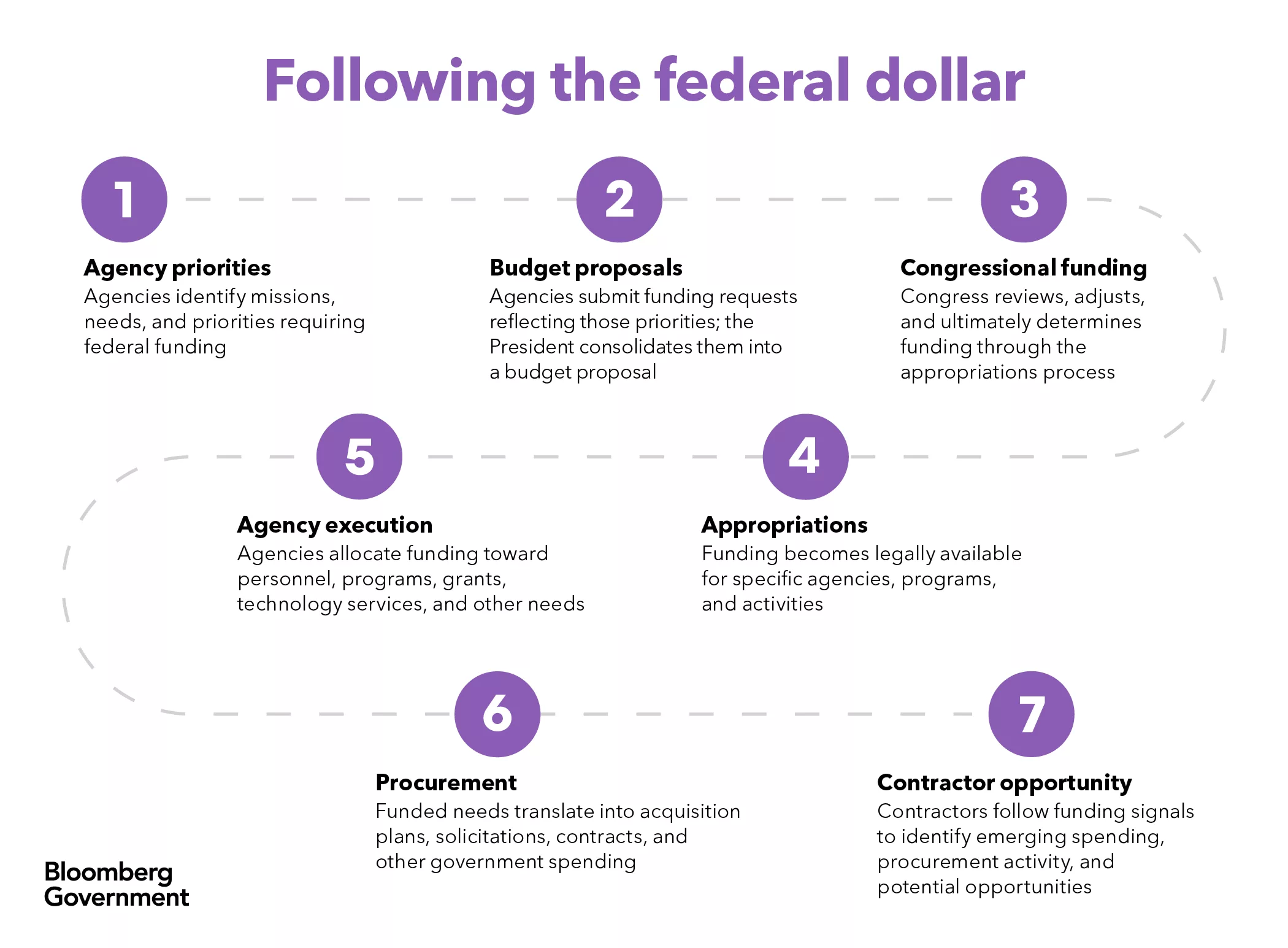
Defense J-Books explain DoD’s proposed spending priorities, helping contractors and government affairs professionals follow those priorities through the federal budget process toward potential procurement opportunities.
Where do J-Books fit in the federal budget process?
DoD components prepare detailed justification estimates each year that support the President’s annual budget request.
In general, here’s how the federal budget process works, including where defense justification books (J-Books) provide insight:
- Agencies identify missions and needs requiring federal funding. DoD’s J-Books explain the defense priorities behind its proposed investments.
- Agency requests inform the President’s budget proposal to Congress. DoD submits supporting J-Books detailing requested funding and program plans.
- Congress reviews requests and determines funding levels through the appropriations process. J-Books provide context for evaluating proposed defense spending.
- Once appropriations become law, funding becomes legally available. Comparing enacted amounts with J-Book requests reveals which defense investments Congress supported or adjusted.
- Agencies allocate available funds to programs and activities. J-Books help stakeholders understand the planned objectives behind defense allocations.
- Funded needs can lead to acquisition plans, solicitations, and contracts. J-Books provide early signals that contractors can track against actual procurement activity.
- Contractors combine J-Book insights with enacted funding and procurement data to assess opportunities. Government affairs professionals use that context to inform advocacy and stakeholder engagement.
The value of justification books is upstream visibility. Reviewing these files can help you gain visibility into proposed funding and program priorities.
What information do J-Books contain?
J-Books provide line-item rationales, schedules, and details on what the DOD is requesting to Congress and why. They typically provide seven years of funding context – though 2026 files did not have forward-looking information – and have typically been released annually in the beginning of the year, after the President’s budget overview.
These files are organized by military department or Defense agency and appropriation account. Typically J-Books can identify the following details:
- Program and budget-line descriptions
- Program Element (PE) numbers for RDT&E and Budget Line Item Numbers (BLINs) for procurement
- Prior-year, enacted/current-year, budget-year, and outyear funding
- Quantities, unit costs, schedules, and acquisition narratives
- Changes in funding, capability scope, or procurement quantities
- In some cases, incumbents/prime contractors and program office information
How to read a J-Book to identify potential contracting opportunities
To read a DoD J-Book, start with a program relevant to your capabilities, compare its funding and planned activity across available years, and read the explanation behind any change. Then follow the funding and acquisition signals to decide what merits further capture work.
- Find the relevant program and budget line: Search by program or capability in the appropriate agency and account, then record the identifier and source.
- Compare funding and quantities across available years: Check funding status and planned quantities to distinguish increased demand from higher costs or scope changes.
- Read the justification and schedule: Review the agency’s rationale and milestones to assess whether the planned work fits your capabilities.
- Check funding decisions and the acquisition path: Follow appropriations and agency acquisition activity to determine whether an accessible contracting opportunity is emerging.
- Set a next action and review trigger: Document your findings, assign an owner, and tie the next review to a funding or acquisition milestone.
What J-Books can and can’t tell you
Justification books explain how much funding the Department of Defense requests from Congress, what it plans to fund, and why. They help identify proposed defense spending priorities and potential future contracting opportunities.
However, J-Books cannot confirm final funding levels or predict contract awards. Congress can adjust requested amounts during appropriations, and enacted funding does not guarantee a specific procurement or an open competition.
The bottom line: Use DoD J-Books to understand spending intent, then track enacted appropriations, solicitations, and contract awards to see what moves forward.
See how Bloomberg Government’s AI-powered experience helps you explore DoD J-Books and track federal funding flows, with references to the specific justification book and page behind each result.
[Watch our on-demand webinar Put Federal Spending Data to Work with AI to see to see how budget and spending research can inform your team’s next steps.]
Why do J-Books matter to federal contractors?
J-Books especially matter to federal contractors because reading these files can help them position their business early for opportunities instead of waiting to react to an RFP.
The bottom line: Use DoD J-Books to understand spending intent, then track enacted appropriations, solicitations, and contract awards to see what moves forward.
See demand before a solicitation appears
DoD J-Books help federal contractors identify potential procurement demand before solicitations are released by enabling teams to:
- Identify proposed investments and planned purchases.
- Assess whether emerging needs match their capabilities.
- Prioritize programs for further capture research.
Understand why an agency is investing
J-Books explain the mission needs behind proposed defense investments, helping contractors:
- Understand the agency’s stated program objectives.
- Connect their offerings to specific capability needs.
- Prepare for agency discussions using documented priorities.
Separate growing programs from static markets
Comparing J-Book funding, quantities, and program narratives helps contractors assess potential market growth by enabling teams to:
- Identify planned increases in purchases or program activity.
- Distinguish expanded demand from higher costs.
- Focus research on programs with evidence of growth.
Build stronger agency account plans
J-Books provide program-level evidence that helps contractors focus agency account planning on relevant investments, enabling teams to:
- Prioritize programs aligned with their capabilities.
- Identify agency needs that warrant further research.
- Ground account priorities in documented funding requests.
How government affairs, BD, and lobbying teams read J-Books
Remember: J-Books can be useful for professionals across a variety of sectors. Consider the following benefits for professionals in these areas.
Government contractors and business development
Government contractors and business development (BD) teams can benefit from reading J-Books when they use this intelligence to:
- Identify emerging defense funding opportunities.
- Align business development strategies with DoD priorities.
- Understand future procurement demand before solicitations are released.
Government affairs teams
Government affairs teams who want to track and influence federal spending can benefit from reading J-Books when they use this intelligence to:
- Understand defense spending priorities.
- Use knowledge about government spending to make informed decisions about advocacy priorities.
Better prepare for meetings by gaining early access to information and specific citations for talking points and requests.
Lobbyists
Lobbyists can benefit from reading J-Books early when they use this intelligence to:
- Track defense funding priorities and make appropriate lobbying decisions.
- Support client advocacy efforts with deeper budget context.
- Understand the rationale behind proposed defense investments.
The problem: J-Books are public but fragmented
While justification books are immensely useful in theory, their fragmented nature has made them difficult to use in practice. These documents span multiple sites and dozens of PDFs, and often have inconsistent formatting across years and services, which means converting tables to analyzable data is a slow, manual process.
Bloomberg Government’s AI-powered tools connect budget proposals, funding decisions, and federal spending to reveal agency priorities and take concrete action from J-Books data.
How Bloomberg Government turns J-Books into usable intelligence
Bloomberg Government’s AI-enabled platform connects DoD J-Books with appropriations and spending intelligence to help teams investigate potential contracting opportunities.
Federal Funding Flow connects budget requests, congressional funding decisions, and contract spending, adding program descriptions and funding rationale from J-Books. Spend Insights lets users ask natural-language questions across budget, appropriations, spending, and contracting data to investigate funding priorities and emerging demand.
Key differentiators of this Bloomberg Government J-Books experience include:
- Integration with appropriations and spending intelligence
- Easier discovery and analysis of defense funding priorities
- Reduced reliance on manual review of spreadsheets and source documents
- A unified workflow for government affairs and government contracting professionals
Bloomberg Government also offers transparency by allowing users to double check the sourcing via PDF icons that link to J-Books. “When you click on [the icon], it’ll actually open up the J-Book itself for you right there. So, that way you can actually look at the official government document,” said Palak Patel, a Bloomberg Government product manager, noting that a key feature of the tool is its unmatched level of detail.
See how Bloomberg Government helps turn defense budget signals into informed capture decisions. Request a demo.
Frequently asked questions
DoD justification books – sometimes called “J-Books,” “DoD J-Books,” or “jbooks” – are typically released in March or April after the White House Office of Management and Budget releases its topline information. Timing can vary by budget cycle and component, and documents may be released in stages.
Without a tool that provides integrated access, like Bloomberg Government, you typically can find budget justification data by combing through the Under Secretary of Defense Budget Materials website (aka the Comptroller site) or via individual military branches. Older budget justification books (1980–1996) are available as digital archives via the Library of Congress’s collection. For easier access, however, you can find budget justification books (J-Books) via Bloomberg Government’s single, integrated platform.
Government contractors can use DoD J-Books strategically to locate relevant programs, compare requested funding and planned activity, and read the justification for changes. They then investigate congressional funding decisions, existing contracts, and agency acquisition signals to assess whether a potential opportunity fits their capabilities.