Federal Contracting: AI Use Cases for Business Development and Capture Teams
Key takeaways:
- Business development and capture teams should use trusted AI tools for business development that are purpose-built for federal contract workflows and deliver accurate, reliable, and transparently sourced results.
- Regulatory developments for AI in government contracting continue to unfold, and organizations should follow government regulations as well as their own internal AI governance rules.
- As federal funding workflows become more complex, Bloomberg Government’s trusted AI-enabled platform gives business development and capture teams reliable and human-verified federal market data.
- In an environment where inaccurate intelligence carries real strategic and reputational risk, Bloomberg Government’s all-in-one platform delivers innovative tools that support the federal contracting process in addition to simplifying legislative and policy analysis.
Trustworthy AI in government contracting is key for business development and capture teams managing federal contract workflows in this ecosystem.
The dynamic, high-stakes environment of federal contracting is typically a reactive process of gathering key information, monitoring market conditions, and managing robust opportunity pipelines across multiple platforms. For busy professionals who want to uncover proactive opportunities and efficiently prepare decision-ready briefings, artificial intelligence can help gain a significant competitive advantage that wins contracts.
Specifically, AI creates the most value for today’s government contracting teams when it combines federal spending/funding and procurement intelligence with purpose-built analysis, transparent sourcing, and workflows designed for business development and capture decision-making.
As federal funding workflows become more complex and as regulatory developments for AI in government contracting continue to unfold, busy teams need trusted, human-verified federal market data, like the kind delivered by the experts at Bloomberg Government.
Read on to learn more about how AI tools for business development can support federal contracting.
AI use cases for business development and capture teams
From building and monitoring an opportunity pipeline to securing federal contract awards, government contracting tasks are often cumbersome and require extensive research that pulls from fragmented information across multiple platforms, spreadsheets, emails, and messages.
As the landscape becomes more complex, trusted AI tools for business development have emerged to offer several key use cases in the federal contracting space, and busy teams are quickly adopting them to gain a leg up in this process.
Business development teams are using trusted AI to help them move more quickly from research to decision-making. Noteworthy use cases include the following action items:
Understanding where the market is moving
Between sudden budget freezes, unexpected cuts, contract wins, and the fast movement of the market, it’s increasingly difficult to understand federal funding – that is, where government money is going and also where opportunities are emerging.
A trusted AI spending intelligence tool can help your business development team take strategic actions, like:
- Connecting policy and federal budget decisions to likely demand
- Sizing a federal market to quickly determine which contracts to pursue.
- Researching agency renewals and priorities
- Tracking appropriations and spending trends to identify where the government is investing.
- Understanding future defense priorities to know what the Department of Defense has requested and why.
The Bloomberg Government advantage
Bloomberg Government is a powerful tool for understanding the market, and we have strategically – and deliberately – paired AI technology with trusted editorial oversight, deep domain expertise, human review, and rigorous model evaluation.
For example, Bloomberg Government Spend Insights surface relevant funding, spending, and federal budget data in seconds so users can better understand agency priorities, strengthen business development and advocacy strategies, and make more confident decisions.
Bloomberg Government News and Analysis provides accurate intelligence on federal and state policy, breaking news, expert analysis, bill tracking, and more, with links to original documentation for quick verification.
And Bloomberg Government’s new defense justification books (JBOOKS) gives subscribers direct access to defense budget justification data. JBOOKS is part of Federal Funding Flow, which offers real-time updates on appropriations, seamless connections between federal budget allocations and spending, and robust historical data to support strategic planning.
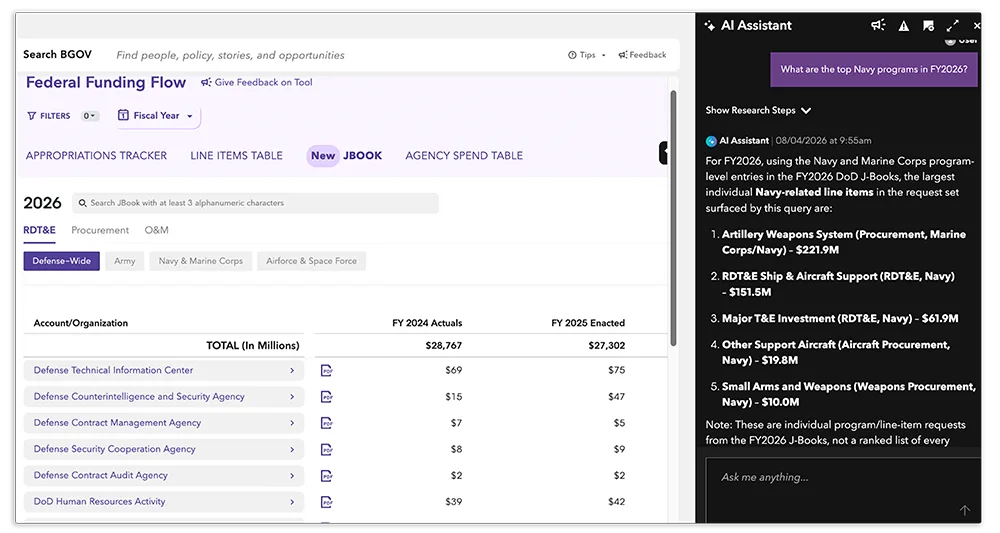
Discover potential growth opportunities aligned with federal funding priorities.
Finding and qualifying the right opportunities
AI tools for business development can help busy teams streamline important and foundational business development workflow tasks, such as.
- Prioritizing opportunities to fit an enterprise’s qualifications.
- Assessing whether funding support exists to make more confident decisions.
- Targeting government outreach to align with specific Program Managers, Contracting Officers, and agency officials.
- Building tailored agency targeting plans to find quality opportunities.
The Bloomberg Government advantage
Researching government spending and funding data can be time-consuming and fragmented, but Bloomberg Government can offer teams a leg up by helping them surface and analyze essential information while also saving time. And Bloomberg Government helps business development and capture teams work together more effectively by providing access to the same source records vetted by a trusted vendor and by allowing teams to make more informed and collaborative decisions.
While our platform doesn’t help teams discover unpublished opportunities, Bloomberg Government features help teams shape new opportunities, identify and evaluate public signals earlier, and gain a competitive advantage.
Strengthening competitive and capture intelligence
When developing a winning strategy for your bid, capturing valuable intelligence is key. A trusted AI tool can help your team with the following tasks:
- Researching incumbents and competitors to efficiently evaluate their strengths and weaknesses.
- Reviewing award histories to anticipate government spending.
- Identifying likely teaming partners to increase your win rate.
- Standardizing business development-to-capture handoffs by centralizing current, reliable data.
The Bloomberg Government advantage
Bloomberg Government helps teams find new opportunities faster and expand their pipeline visibility, and it does so by relying on the provision of complete, current, and traceable federal contract awards data – and by using the most powerful search tools on the market. With our trusted tools, your team can focus on gathering competitive intelligence and securing bids.
Turning research into decisions
Top-tier opportunity research ideally should be followed by confident action. As your team tries to win the deal, consider the following ways that trusted AI can help you make more strategic and informed decisions.
- Summarize funding and market findings so you have reliable visibility into spending patterns.
- Support bid/no-bid discussions so you can quickly determine which opportunities to pursue or skip.
- Share a common source of intelligence across teams and avoid having details and opportunities fall through the cracks.
- Leverage insights to draft better proposals based on existing RFPs, solicitations, contract data, etc.
The Bloomberg Government advantage
When developing a proposal, the accuracy and quality of your intelligence matters. Having access to the same source records vetted by a trusted vendor can give your teams the key details they need to collaborate on deadline.
How to know if you can trust an AI output
AI tools are entering the government affairs and contracting market at a rapid pace. However, some AI tools rely on the open web and generic large language models that can produce incomplete, inaccurate, or hallucinated results.
Picture the problems that can result from untrustworthy AI outputs: Boilerplate language that completely misses the operation reality of the customer. An inaccurate market number used in a bid decision, and nobody notices until the debrief.
The source of an AI tool’s unreliable outputs lies in the data that the tool reads. That’s why it’s so important to understand what makes an AI output unreliable – and to find a trusted tool that can give your teams accurate and transparently sourced results.
Consider the following red flags for AI in government contracting:
- The tool covers only part of the available federal data
- The federal contract awards records are out of date
- The AI cannot show the record or source for its answer
None of these red flags are visible in the output itself, because a thin or inaccurate answer and a well-sourced one can look the same. You may want to ask yourself the following questions to help determine whether a tool’s sourcing is trustworthy.
- Can we see which records produced the tool’s answer?
- Is the source authoritative or is it scraped from the internet?
- When was each source last refreshed?
- Does the tool report what it could not find, or only what it found?
- Can we validate the answer by reviewing the source?
In contrast to general-purpose or untrustworthy AI tools, Bloomberg Government goes far beyond republishing data. Our solution adds value by organizing, enriching, contextualizing, and connecting federal spending/funding data with historical intelligence, expert analysis, and proprietary content.
Bloomberg Government’s AI capabilities remain grounded in proprietary federal spending and solicitation intelligence, authoritative legislative and regulatory data, verified editorial content, and transparent sourcing – not public web scraping.
Regulatory and compliance considerations
“Government contractors operate in one of the most heavily regulated business environments in the world,” confirms a June 2026 article in the National Law Review. That regulatory scrutiny means federal contractors must be aware of current and pending regulatory and compliance considerations for the use of AI, including those that operate under CMMC 2.0, NIST 800-171, FedRAMP, ITAR, and FISMA, per a March 2026 article from Kiteworks, a platform that delivers data governance, compliance, and protection.
Recipients of federal contract awards also must consider evolving news and proposed regulatory changes if considering the use of AI in government contracting.
For example, earlier this year the Pentagon said it had formally notified Anthropic PBC that it had determined the company and its products posed a risk to the U.S. supply chain, according to a March 2026 Bloomberg News report. Anthropic subsequently challenged this designation in court, and a federal judge issued a preliminary injunction to block enforcement while litigation moved forward.
In June 2026, the U.S. General Services Administration (GSA) published a proposed rule in the Federal Register introducing GSA Regulation 552.239-7001 on the safeguarding of data within large LLMs, which served as a “significant revision” to the GSA’s March 2026 draft, reported global law firm Holland & Knight noted in a June 2026 alert. If adopted, it “will impose substantial and wide-ranging obligations” on contractors providing AI solutions to the government, with key obligations including “strict government data ownership and use restrictions, ‘eyes off’ data handling requirements, U.S. jurisdictional controls on LLMs, robust incident reporting and a new ‘Unbiased AI Principles’ framework with potential termination-for-cause liability,” per the Holland & Knight alert.
As these developments unfold, teams and organizations should continue to follow current government regulations as well as their own internal AI governance rules, including refraining from entering any protected, proprietary, or sensitive information into unapproved tools.
Organizations also should reinforce human review for all proposal, pricing, and compliance decisions. While trusted AI tools for business development can help teams work more efficiently, human review is still a crucial part of the contracting process.
How Bloomberg Government makes contracting intelligence more accessible
In an environment where inaccurate intelligence carries real strategic and reputational risk, Bloomberg Government gives your team the confidence to act because every insight is backed by the trusted foundation only Bloomberg can provide.
Bloomberg Government serves users by combining proprietary federal spending/funding and contracting data, expert analysis, transparent sourcing, and purpose-built AI to help teams identify opportunities and make more informed pursuit decisions.
Although Bloomberg Government is not a general-purpose proposal writing tool, it is the trusted intelligence and analysis platform that supports contracting intelligence workflows. For example, Bloomberg Government Spend Insights connects federal budget, appropriations, contracting, and defense data so users can understand relationships across datasets and receive more decision-ready answers.
The advantage of using Bloomberg Government goes beyond its access to government records, and its key differentiators follow:
- Proprietary and enriched data
- Deep historical government intelligence
- Authoritative reporting
- Expert analysis
- Transparent sourcing
- Federal spending and solicitation intelligence
The bottom line: Bloomberg Government’s all-in-one platform uses more than a decade of AI expertise to deliver innovative tools that support the federal contracting process in addition to simplifying legislative and policy analysis.
Want to learn more about how Bloomberg Government can help your team find relevant opportunities, understand agencies and competitors, and prepare decision-ready briefings? Request a demo.
Frequently asked questions
It depends on the AI. It is not advisable to rely on general-purpose AI tools for sensitive bid/no-bid decisions because these tools can provide incomplete, inaccurate, or hallucinated outputs. Additionally, general-purpose tools can have privacy risks. However, a trustworthy AI-enabled platform with privacy safeguards, such as Bloomberg Government, can be a helpful tool when used along with human review of its outputs.
While government contractors may be permitted to use securely operated and enterprise AI in general, some contracts, agency policies, or federal regulations may limit or restrict the use of AI in government contracting. When AI use is permitted, contractors should understand the stated guidelines and stay in compliance, and they must disclose AI use when required.
Most general-purpose AI platforms rely primarily on publicly available web content and often lack the authoritative, unbiased data, historical context, and domain expertise required for high-stakes government decision-making. Bloomberg Government is different from general-purpose AI chatbots and tools because it is an authoritative, subscription-based service that provides comprehensive and transparently-sourced information and analytics for professionals who interact with – or are affected by – the government.